
News
Grab Bars and Care Beds Move to Rental as Japan's Model Spreads
China's Ministry of Civil Affairs and five other departments published a fourteen-point package on 6 November that reframes how age-friendly equipment is bought. Alongside the usual calls for better products, the measures promote rent-to-own and lease-purchase arrangements for age-friendly home goods, assistive devices and smart care equipment, and ask communities to open trial and rental counters inside existing service centres. The wording matters because it aims at the cost of access rather than the cost of goods. A family that will not spend several hundred dollars on a care bed in one move will still lease one for eighteen months after a fall, and a city that subsidises a rental fleet can reach ten households for the price of three outright sales.
Japan already runs that playbook, and the figures are clear. Under long-term care insurance, rental is the default channel rather than the exception: health ministry data puts leased equipment at 91.3% of welfare equipment spending in fiscal 2025, with purchase grants reserved for items that cannot be reused. A separate fitting and monitoring fee, introduced in 2024, now absorbs 18.6% of equipment spending, which suggests the service layer rather than the hardware is where margin sits. The pressure behind the shift is arithmetic. The ministry counts a shortfall of roughly 250,000 care workers today, widening to 570,000 by 2040, while premiums for workers aged 40 to 64 rose from 1.59% to 1.62% in April. Several prefectures now cover up to 80% of the cost of transfer robots and exoskeletons; Tokyo's rate is commonly three quarters.
Demand in the United States arrives from the other direction: through housing. Census estimates put 61.2 million Americans at 65 or older, 18.0% of the population and 13.0% more than in 2020, and AARP surveys find 75% of them want to stay put. The 2026 Houzz bathroom study shows what that resolve looks like on a quote sheet: 71% of renovating homeowners tackled special needs, and for 55% of them the need was still five years away. Grab bars led at 63%, ahead of non-slip flooring at 56% and low-curb showers at 55%; curbless showers reached 32%, ADA-height toilets 24% and wheelchair-accessible doorways 19%. Walk-in tubs, the costliest answer, were 2% of tub replacements. Households are buying prevention in cheap components rather than a rebuild, which is ageing in place expressed as a purchasing pattern.
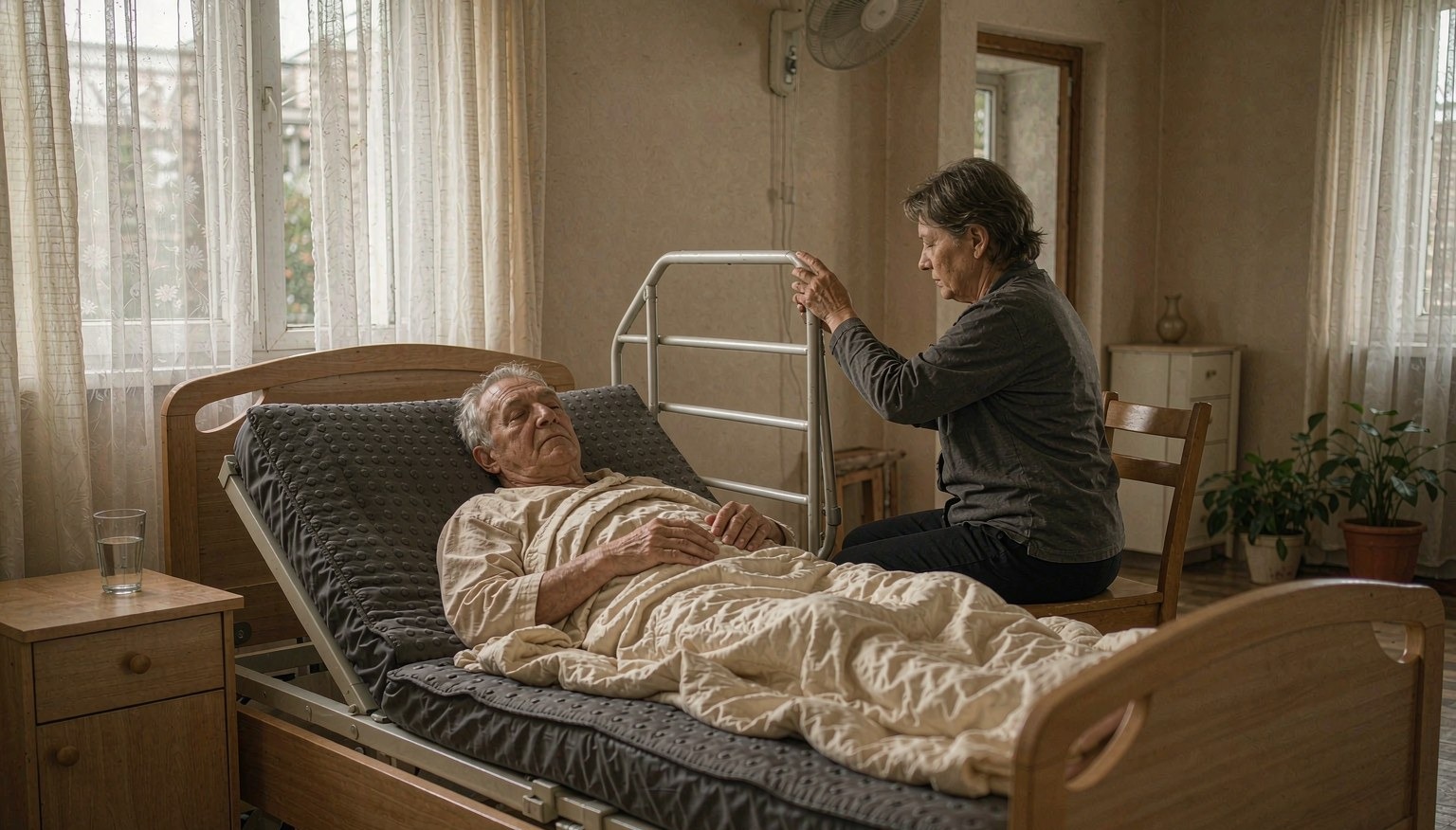
That distinction runs through the product list. In the bathroom, a grab bar, a shower chair and a non-slip bath mat cost little and install in an afternoon, while a raised toilet seat, a toilet safety rail and a commode chair solve the harder half of the room. In the bedroom, a bed rail and a bed assist bar keep a frail occupant from climbing out unattended, a pressure relief mattress protects skin, and a fall detection radar or bed exit alarm covers the hours when nobody is awake. At the table, adaptive utensils, a divided plate, a two-handled cup and a non-slip plate restore eating without help. Outdoors, a rollator, a folding wheelchair and a walking frame decide whether the front door gets used at all.
Rental changes what should be built. Installed grab bars run USD 150 to 500 each and a fold-down shower seat USD 300 to 800, against USD 8,000 to 15,000 for a curbless shower and USD 2,000 to 6,000 for a prefabricated stall, so the accessory layer carries the volume and the lease arithmetic. But a leased item returns to the depot, which rules out foam that cannot be disinfected, coatings that chalk, and fittings that need a specialist to adjust. Modular rails with tool-free brackets, removable padded covers, standard bolt patterns and printed spare-part lists are worth more in a rental catalogue than a tenth of a millimetre of wall thickness, and the same holds for a care bed with interchangeable motors or a shower chair whose legs can be reordered alone.
China's retrofit gap explains why the policy exists. Roughly 2.24 million households with special difficulties had been adapted by end-2025, yet urban penetration stays below 6% and rural accessibility coverage below 30%. The safety case is blunt: the national disease control centre attributes at least 40 million falls a year to older people, half of them at home, and studies credit systematic modification with cutting falls by up to 40% and grab bar installation with reducing injury by roughly 39%. Two judgments follow for exporters of elderly care products.
The first is that a rental fleet is a documentation business. A distributor moving into leasing will ask for cleaning and disinfection protocols, batch traceability, and a five-year parts commitment before discussing price, and the standards guide plus certification scheme promised in the package will turn those requests into paperwork. The second is that quoting FOB per unit loses to quoting cost per household per year, because the customer is now a home care operator balancing a fleet of senior care supplies, not a buyer filling a container. The silver economy is being repriced around access: a supplier who can ship one spare bracket in year four beats the one who quoted lowest in year one.
Yiwu Orange Light Future Technology keeps a close eye on global trends in elderly health. Specializing in age-friendly wellness products, we offer a range of mature solutions to support seniors' safety and health at home. We welcome inquiries and business discussions from all partners!
RELATED NEWS
- Technology Empowers Later Life: Europe and US Accelerate Deployment of Smart Wal
- Adapting to an Ageing Society: Global Nations Boost Healthcare Security for Olde
- Asia-Pacific Joins Hands for Healthy Ageing: Primary Healthcare as the Core Driv
- Silver Tourism Nears $2T: Healthy Travel Drives Core Growth
- 30‑Year Harvard Cohort Research Reveals Few People Achieve Full Healthy Ageing
CATEGORIES
LATEST NEWS
CONTACT US
Name: Fannie
Mobile:+86 13375799060
Tel:+86 13375799060
Whatsapp:+86 13375799060
Email:fannie@ywolftech.com
Add:589 Longtan Road,Jinhua City Zhejiang Province China