
News
Grab Bars and Shower Chairs Retool as Solo Households Become the Norm
Germany's Federal Statistical Office published a household projection on 5 November that quietly overturns an assumption most of the senior products industry still plans around. One-person households will rise from 17.9 million in 2024 to between 18.5 and 19.2 million by 2050, while every larger household type shrinks in all three calculated variants, and the share of people living alone climbs from 21 percent to 23 or 24 percent. Growth is concentrated among the over-60s. Taiwan arrived at the same milestone from the opposite direction: its 2025 family income survey put one-person households at 17.33 percent, overtaking four-person households at 16.63 percent for the first time. The customer is no longer a family buying equipment for a parent. Increasingly the customer is the parent, buying and installing alone.
Governments are already budgeting for the absence of a co-resident. Japan's parliament enacted revisions in November obliging municipalities to run check-ins, manage hospital admissions, settle paperwork after death and arrange funerals for elderly people with no reliable family, a group projected to grow from 2.86 million in 2024 to 4.48 million by 2050, targeted for June 2028. South Korea's 2026-27 winter plan, presented on 10 November, commits daily calls or visits to 566,000 vulnerable older adults during cold waves and supplies emergency monitoring equipment to 278,000 households of people living alone. Hong Kong has fitted smart accident detection systems in 450 high-risk flats, logging five detected accidents by the end of September. These are not care programmes so much as substitutes for a person who is not in the building.
The substitution rewrites what a product must do before it does anything clinical, and it is the practical edge of ageing in place. Most of the category assumes a second adult standing nearby to hold a door, pass a towel or take weight during a transfer. A solo household has none of that, and the housing stock compounds it: rented flats, tiled walls that will not accept an anchor, doorways too narrow for equipment to pass. That is why a suction grab bar and an L-shaped grab rail for renters have moved from travel accessory to core range, and why a shower chair with arms, a shower stool for a standard cubicle, a transfer bench that straddles a bath rim without drilling and a raised toilet seat now sell on setup time rather than load rating. A commode chair quietly replaces three products for someone who cannot cross a corridor at night.
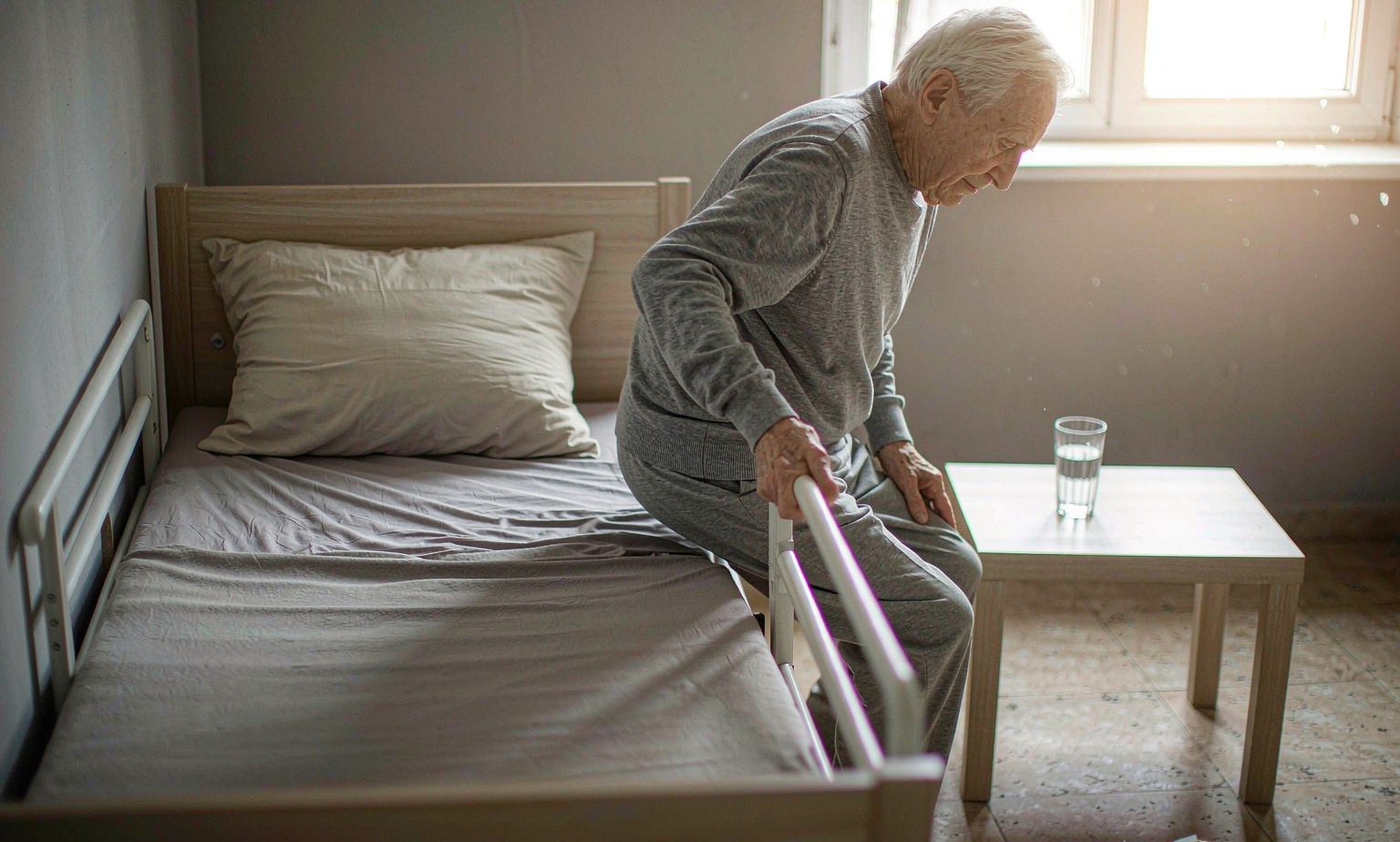
The bedroom carries the same logic. A bed rail or bed assist bar supplies the handhold for a sit-to-stand that a spouse used to assist, an adjustable bed raises the head end so a resident can eat without stacking pillows, and an overbed table keeps a meal, a phone and a pill organizer within one arm's reach. None of it is sophisticated; all of it removes a request for help. Elsewhere the requirement is simply reach and grip: a reacher grabber for a dropped remote, a motion sensor light on the route to the toilet, adaptive utensils and a non-slip plate that let one hand do the work of two, a two-handled cup for tremor, and a rollator or folding wheelchair that stores in a hallway, not a garage. The purchase is rarely one item but a set assembled over months, precisely the basket a home care wholesaler wants to fill.
Monitoring gets the headlines and earns them only partly. A fall detection radar, a bed exit alarm, a smart mattress with remote patient monitoring and an emergency call button all shorten the gap between an incident and a response; in Korea the cheapest version of the idea is a smart plug that flags a household when an appliance has drawn no power for a day and a half. America's Centers for Disease Control and Prevention count about one in four people aged 65 and over falling each year, with 4.5 million emergency visits, and fewer than half tell a doctor. China's 2026 falls report places about 68 percent of falls inside the home. A sensor reports an event; it does not prevent the hand that was absent. That is why radar has not cannibalised grab bars, and why the two are increasingly specified together.
For buyers, the signal is where renovation money actually lands. The 2026 Houzz bathroom study found 71 percent of renovating homeowners addressing special needs, led by grab bars at 63 percent, non-slip flooring at 56 percent and low-curb showers at 55 percent, while walk-in tubs were just 2 percent of tub replacements. Installed grab bars run USD 150 to 500 each against USD 8,000 to 15,000 for a curbless shower, so volume concentrates in small assistive devices that ship in a carton and install in an afternoon. Two consequences follow for senior care supplies buyers. Packaging has to be instruction-led: the end user is often the installer, with nobody to fall back on. And tool-free assembly, 500 to 550 pound bariatric ratings and renter-friendly mounting are turning from premium features into tender requirements. Suppliers quoting only per-container pricing, with no photographed installation sequence and no spare-parts path, will lose the listing.
Yiwu Orange Light Future Technology keeps a close eye on global trends in elderly health. Specializing in age-friendly wellness products, we offer a range of mature solutions to support seniors' safety and health at home. We welcome inquiries and business discussions from all partners!
RELATED NEWS
- CIIE and Canton Fair Shift Age-Friendly Products to Self-Purchase
- Singapore Revamps Public Transit for Dementia-Friendly Communities
- International Elderly Care Guide: Guidelines for Proper Commode Chair Use Releas
- Mediterranean Diet Confirmed to Boost Brain and Cardiovascular Health for Senior
- WHO Urges Global Restructuring of Elderly Care Systems to Advance the UN Decade
CATEGORIES
LATEST NEWS
CONTACT US
Name: Fannie
Mobile:+86 13375799060
Tel:+86 13375799060
Whatsapp:+86 13375799060
Email:fannie@ywolftech.com
Add:589 Longtan Road,Jinhua City Zhejiang Province China