
News
Exoskeletons and Rehab Robots Take the Home Care Floor at MEDICA
When MEDICA and COMPAMED opened in Düsseldorf on 16 November, the floor plan said more than the press releases did. Messe Düsseldorf has rebuilt the world's largest medical trade fair around five thematic pillars, and one of them now carries the label Integrated Care, Rehabilitation and Homecare, with rehabilitation and sports medicine grouped in Hall 4 while home care, consumables and hygiene take Halls 5, 6, 7a and 7.0. Products meant to be used beside a bed or in a bathroom, rather than on a ward, now sit on the main visitor route of a fair that drew roughly 5,300 exhibitors and 78,000 trade visitors from 165 countries at its 2025 edition.
The reorganisation is not housekeeping. This year's edition runs to 19 November with several thousand companies from about 70 countries, more than 900 speakers, a first European Wearable Technologies Conference and a Hospital Procurement Summit on the closing day aimed at buyers who negotiate supply-chain resilience rather than clinical features. Carmen Berger, who directs both fairs, framed the shift as relevance over sheer size: a platform has to push innovations into application instead of merely displaying them. The same instinct surfaced in Asia a fortnight earlier, when the 20th China Senior Industry Expo in Chongqing built a supervised walking track where visitors could try knee and waist exoskeletons.
What justifies the relabel is the hardware. Consumer-grade exoskeletons have fallen in price faster than almost anything else in this industry: a passive hip-assist unit launched in 2025 at roughly 2,500 yuan sold out in fifteen seconds, and the current generation weighs around two kilograms. One flagship, GoGo-H Pro, is marketed as the first exoskeleton for the home, from a company with devices in more than 1,900 medical institutions and over 1.1 million assisted walks. A competing hip unit weighs 1.85 kilograms, folds into a backpack, delivers more than 60 newton-metres of peak torque across eight assistance modes and is registered as a consumer electronic product rather than a medical device. IDC put China's 2025 exoskeleton market above 1.6 billion yuan on about 26,000 units, and third-quarter retail tracking shows the rehabilitation robot moving from hiking and outdoor use toward elderly walking assistance.
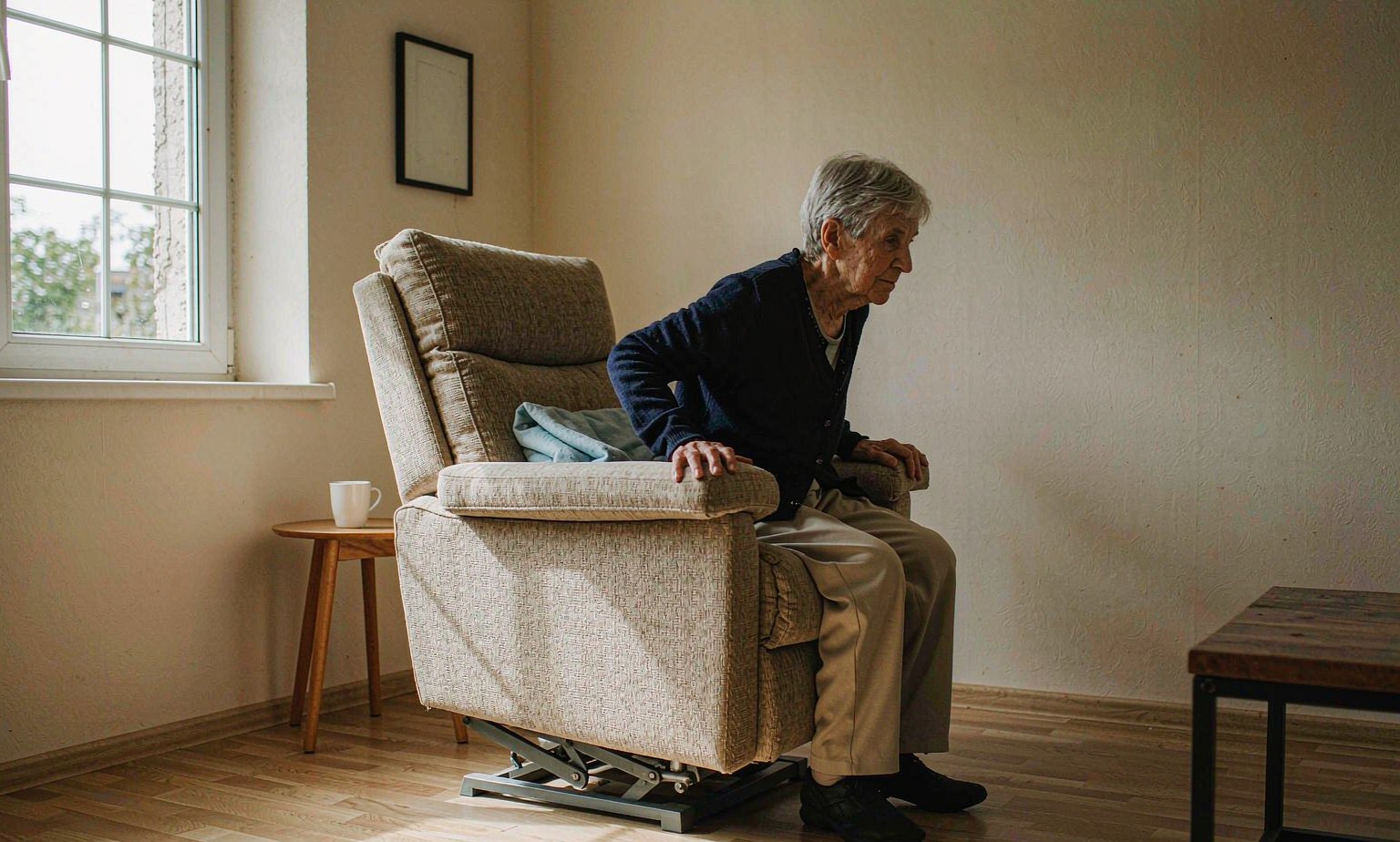
None of that removes the need for the unglamorous stock used every single day. An exoskeleton is close to useless in a wet bathroom of three square metres, which is why shower chairs, wall-mounted grab bars, bath lifts, raised toilet seats and non-slip bath mats stay the first purchase in almost every retrofit. In the bedroom the equivalent set is an electric nursing bed or adjustable bed, a bed rail, a pressure relief mattress and fall detection that manages without a camera; a smart care bed logging bed-exit events is increasingly what families ask for before they ask for a robot. At the table, overbed tables, adaptive utensils, two-handled cups and divided plates do more for dignity than any motor. Along the corridor, the rollator walker, walking aid, folding cane, transfer board, gait belt and mobility scooter still carry the daily load, with a lift chair or riser recliner solving the movement that defeats most people.
For distributors, the practical lesson is that catalogues built around outdoor and hiking exoskeletons now hold the wrong inventory. One flagship model moved from 7.5 to 33.9 per cent of category share in a single quarter on revenue growth of 357.7 per cent, a white-goods brand entered at 2.3 per cent, and a later mover jumped from 0.3 to 2.1 per cent after one launch window, while the top three brands took 84.9 per cent of sales, up 3.9 points on the previous quarter. Concentration is rising, not falling. What moves is rarely a solo device but a bundle of assistive devices covering standing, walking, washing and eating, sold to one household and often to one caregiver, so a supplier able to quote a bathroom set, a bedroom set and a mobility set on a single purchase order holds a structural advantage over the specialist.
The supply-chain argument is equally blunt. Core components account for roughly 45 per cent of an exoskeleton's value, so whoever controls actuators, reducers and battery packs decides whether the retail price keeps falling. Chinese policy pushes the same way: a three-year action plan issued in July by the Ministry of Civil Affairs and thirteen other departments names care robots, brain-computer interfaces, prosthetics and hearing aids as priority segments. For overseas buyers this changes the questions worth asking. Whether a device is filed as consumer electronics or as a medical device sets the certification route, the claims allowed on the box and the returns process in Europe and North America, where ageing in place has turned the living room into a care setting. MEDICA closes on 19 November, the same day its procurement summit convenes, and the useful output will not be a booth photograph but a marked-up hall map of which suppliers have moved into home care. Monitoring, mobilisation and daily living are converging into one household budget line, and the companies that price age-friendly products as a system rather than as gadgets will set the price for the other three.
Yiwu Orange Light Future Technology keeps a close eye on global trends in elderly health. Specializing in age-friendly wellness products, we offer a range of mature solutions to support seniors' safety and health at home. We welcome inquiries and business discussions from all partners!
RELATED NEWS
- Active Ageing: Seniors Rebuild Self-Worth via Travel and Social Connection
- Three Healthy Habits: Eat Well, Keep Moving, Stay Social to Guard Senior Memory
- Singapore Rolls Out New Rules: Medical Assessment Required for Mobility Aids on
- Silver Fitness Sweeps Europe: Older Adults Use Strength Training to Reduce Falls
- Asia-Pacific Joins Hands for Healthy Ageing: Primary Healthcare as the Core Driv
CATEGORIES
LATEST NEWS
CONTACT US
Name: Fannie
Mobile:+86 13375799060
Tel:+86 13375799060
Whatsapp:+86 13375799060
Email:fannie@ywolftech.com
Add:589 Longtan Road,Jinhua City Zhejiang Province China