
News
Europe's Age-Proof Housing Push Runs Into a Grab Bar Retrofit Gap
Europe's senior lobby put home adaptation on the policy map on 6 November, when the European Seniors' Union closed its autumn conference in Bergen, Norway, with a declaration that treats an accessible bathroom as infrastructure rather than a private luxury. The Bergen Declaration asks EU institutions and national governments to make ageing in place a genuine choice, backed by ten priorities that run from affordable housing to what it calls the missing middle between independent living and institutional care. The timing is hard to ignore: the World Health Organization counts roughly 680,000 fatal falls a year, most of them among people over 60, and about 30 percent of community-dwelling adults over 65 fall annually, rising to half of those past 80.
The declaration's most practical clause concerns renovation. It argues that housing costs for older households include energy, maintenance, insurance and adaptation, not just rent, and that renovation should help pensioners on modest incomes make homes safer without fuel poverty. It also wants housing and care planning joined up at municipal level, and calls on the next EU budget to fund age-friendly housing through cohesion policy. No money has been allocated yet, and housing remains a national competence, which is why the document reads as a procurement signal rather than a law. In Brussels and several national capitals, grab bars, shower chairs and bed rails are being reclassified from discretionary consumer goods into public health expenditure.
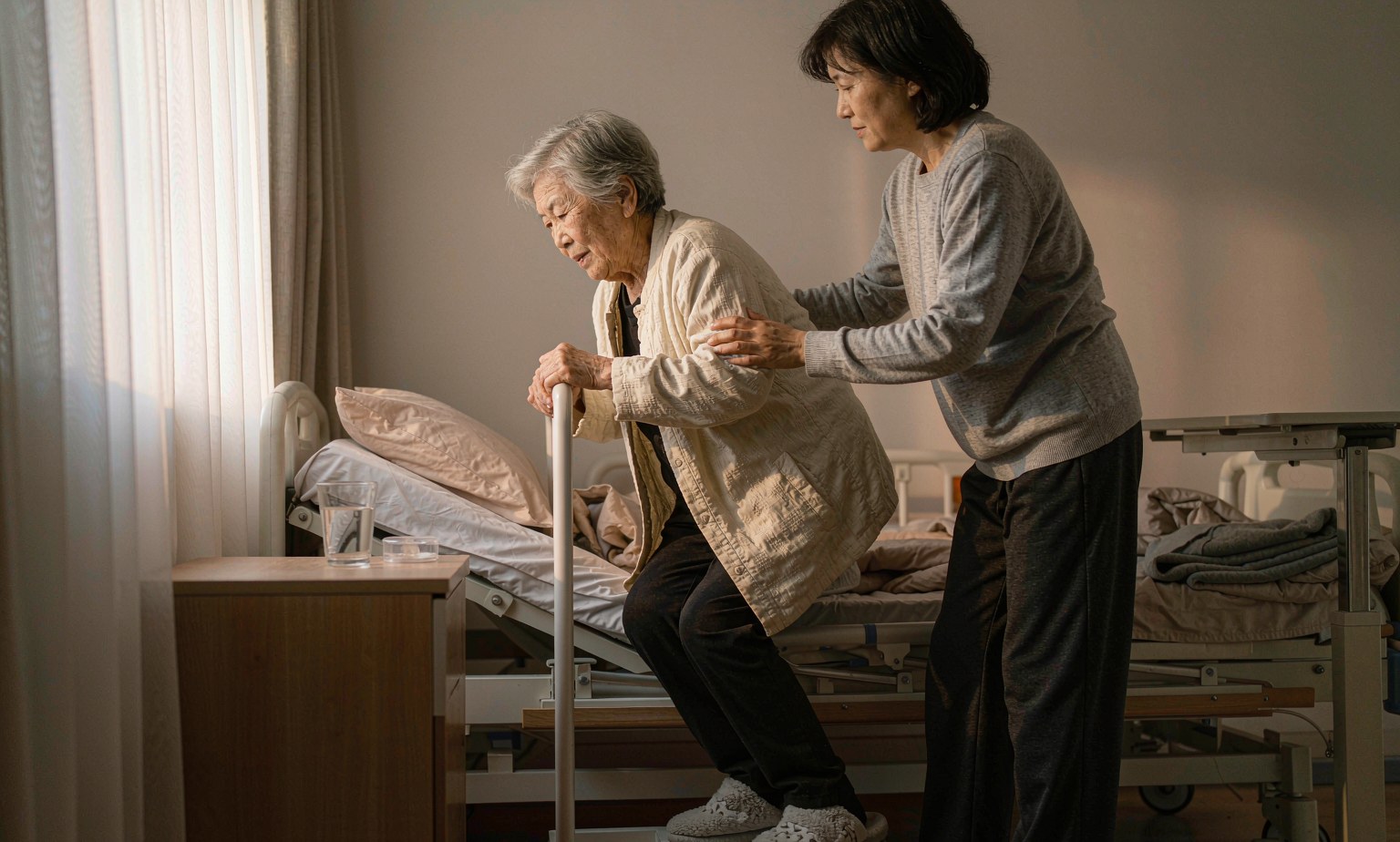
The gap between that framing and what gets installed is where the commercial story sits. Shanghai's Chongming district runs one of the largest voluntary home modification programmes anywhere: organised with a charity foundation, the Fushou project had completed 10,284 households and fitted 21,794 devices across 73 villages by the end of October 2026, after 2,142 households and 4,589 devices in 2025. Each home is assessed before anything is drilled, then fitted with grab bars beside the toilet and inside the shower, a shower chair and a bedside rail. That is roughly two devices per household, which shows how modest the average job is: not a renovation, a few well-placed anchors. A 2026 Tmall home trend report found 58.7 percent of Chinese households with older residents consider their housing unsuitable, rising to 63.2 percent in rural areas, with missing support points cited by 62.5 percent and badly placed storage by 46.6 percent.
Specified as product, the demand clusters into four rooms. The bathroom is simultaneously the highest-risk and the highest-volume: a wall-mounted grab bar at the toilet and a second inside the shower, a shower chair or bath seat sized to fit a tub the household will not rip out, a raised toilet seat or toilet safety rail during knee and hip recovery, a commode chair for nights when the walk is too far, and a non-slip bath mat that stays flat when wet. The bedroom is quieter but compounding: a bed rail or bed assist bar to stand up against, an adjustable bed or electric nursing bed once a carer is involved, an overbed table, a positioning pillow, and increasingly a bed exit alarm for households managing dementia. The dining table is where independence is most visible to a visiting family member, which is why adaptive utensils, a plate guard, a two-handled cup and a divided plate sell in small but repeatable quantities. The doorway is where everything begins: a rollator walker, a folding walking frame, a quad cane and a transport wheelchair for clinic appointments. Fall prevention works before the ambulance arrives, and that argument sells a room rather than an item.
The hardware economics are moving with the policy. The global grab bar market was valued near USD 730 million in 2024 and is forecast to reach about USD 1.14 billion by 2034, a 6.7 percent annual rate that looks unremarkable until you see where the growth sits. Stainless steel still accounts for roughly 64 percent of units, yet the fastest-moving segments are built for small flats and renters: swing-up and folding rails, floor-mounted posts where there is no stud worth drilling, and finishes that pass as ordinary bathroom fittings, because close to a third of buyers now reject anything clinical. The winning product in 2027 is less likely to be a better bar than a better kit: one carton covering toilet, shower and bedside for a single flat, with a drilling template and a load rating on the box.
For importers, the consequence is a change in how you buy, not what you pay. Publicly funded retrofit schemes and insurer-backed hospital discharge packages purchase in bulk and audit in detail, so documentation matters as much as price: consistent load ratings, salt-spray results, and which wall substrate each fixing is approved for. Those buyers want a room, not a catalogue, which pushes suppliers toward bundling a grab bar with a shower chair and a commode chair under one SKU and one carton size, and toward holding elderly care products stock near the destination market instead of shipping loose units on demand. The second shift is service. Cheap suction grab bars still move in volume on marketplaces, but every return is a trust problem, and the category is splitting into a low-cost travel segment and a specified, installed one. Suppliers who support the second with installation guides, spare fixings and stable lead times will hold the accounts this declaration creates, while those competing on price alone keep fighting the same thousand listings.
Yiwu Orange Light Future Technology keeps a close eye on global trends in elderly health. Specializing in age-friendly wellness products, we offer a range of mature solutions to support seniors' safety and health at home. We welcome inquiries and business discussions from all partners!
RELATED NEWS
- Recurring Heatwaves Across Europe: Nations Launch Emergency Schemes to Safeguard
- Age‑Friendly Innovation: Global Markets Boost Senior Safety and Health for the E
- Scientific Research Decodes Keys to Healthy Longevity Among Older Adults
- Global Rise of Silver Volunteering: Seniors Share Experience to Give Back
- Caregiver Tips: 5 Things to do for Long-term Bed Rest Care
CATEGORIES
LATEST NEWS
CONTACT US
Name: Fannie
Mobile:+86 13375799060
Tel:+86 13375799060
Whatsapp:+86 13375799060
Email:fannie@ywolftech.com
Add:589 Longtan Road,Jinhua City Zhejiang Province China