
News
Care Worker Shortage Turns Patient Lifts and Nursing Beds Into Staffing Strategy
Britain closed the 2025/26 financial year with 1.02 million filled direct care posts and 65,000 of them empty, and the overseas recruitment channel that masked that gap for three years is narrowing: arrivals of foreign care workers fell from 105,000 in 2023/24 to roughly 30,000 in 2025/26, and The King's Fund expects about 10,000 in 2026/27. Domestic supply is thinning in parallel, with 140,000 British starters against 175,000 leavers. For manufacturers of elderly care products the conclusion is uncomfortable but useful. Equipment is no longer specified to make a room look safer. It is specified to replace a pair of hands that will not turn up.
The squeeze is not British. Japan's health ministry has modelled a shortfall of 570,000 long-term care workers by fiscal 2040 and now attaches reimbursement bonuses to facilities that install monitoring sensors and care robots. Germany expects up to six million people to need nursing support in the coming years while absorbing only 7,000 to 10,000 Vietnamese trainees annually, roughly 35 to 40 percent into nursing. Taiwan licensed 121,740 residential care beds but could open only 116,840, and 87.5 percent of its institutions report chronic understaffing, a quarter of them severely. Capital is responding to the arithmetic: patient lifting equipment is valued at USD 7.21 billion for 2026 with home care the fastest-growing application segment, and household assistive devices for older people are compounding at about 10.2 percent a year toward USD 9.87 billion by 2032.
That imbalance rewrites the spec sheet. A device bought by a nursing home with forty trained staff can assume ceiling anchors, two operators and a maintenance contract. A device bought by a 74-year-old spouse caring alone cannot assume any of it. The result is a migration toward products one untrained person can deploy inside an ordinary flat: a transfer board that slides beneath a seated parent without a lift, a gait belt with four padded handles for a two-step pivot, a standing aid that turns an armchair into a stable support, a transfer bench that straddles a bathtub rim without drilling, a lightweight wheelchair that folds into a car boot. My reading of current order flow is that the winning SKUs are no longer the most capable ones but the ones with the shortest setup time and the fewest installation prerequisites.
The bedroom carries the heaviest load, because it is where dependent care actually happens. An electric nursing bed with independent backrest and knee-break motors removes the manual pull that ruins caregivers' lower backs, and a height-adjustable frame lets one person work at hip level instead of stooping. Add a safety bed rail for the confused night-time riser, a pressure relief mattress for anyone lying more than fourteen hours a day, and an overbed table that turns meals and medication into something the resident handles alone. Smarter configurations earn their premium where night cover has gone: a smart care bed that logs exits, a bed exit alarm, or a fall detection radar substitutes an alert for a physical round, which is the only night care many operators can still staff.
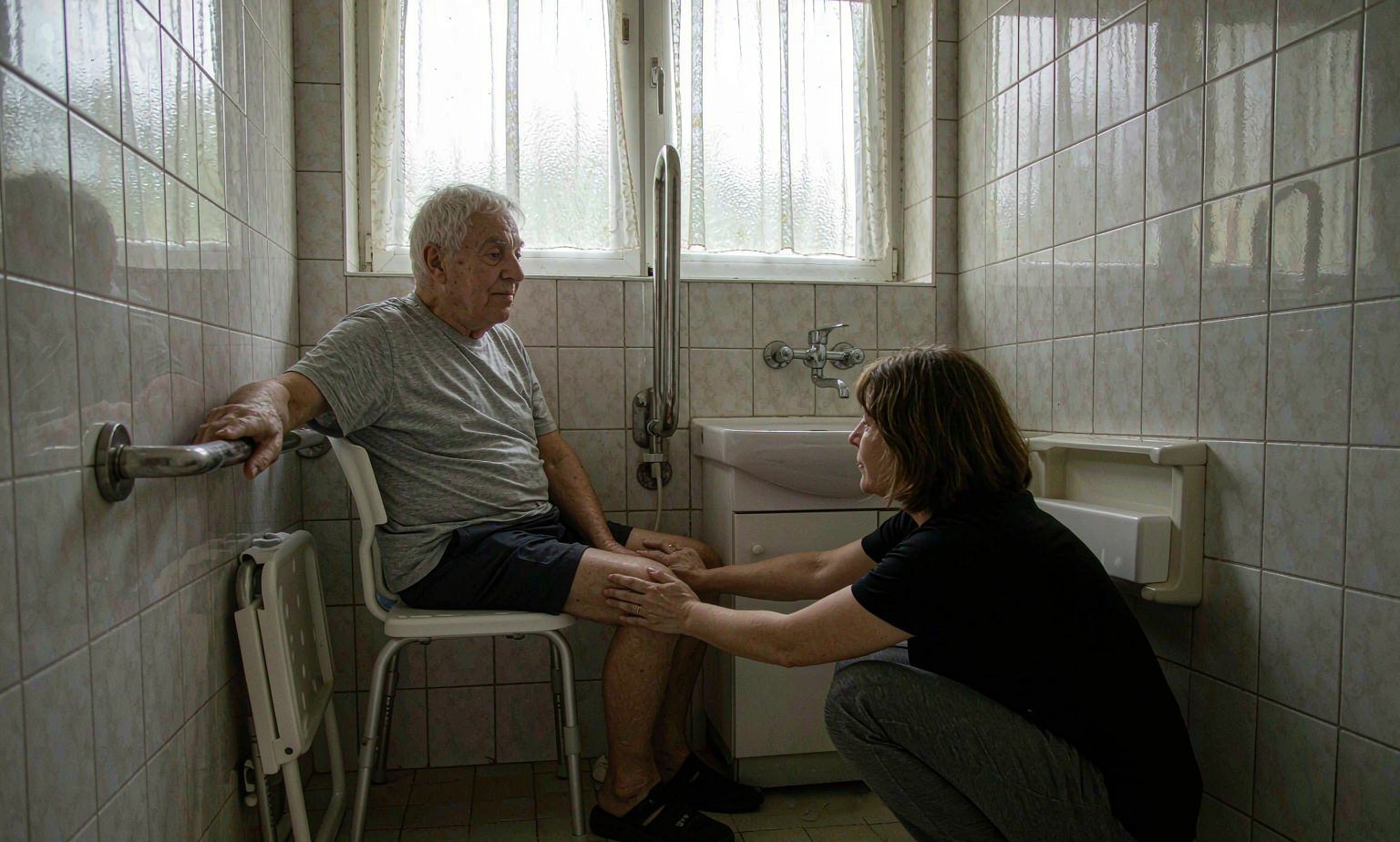
Bathrooms concentrate risk in little space. A shower chair with arms, a commode chair doubling as a bedside toilet, a raised toilet seat and a grab bar fixed at the correct height turn a room that causes falls into one that tolerates them, while a non-slip bath mat costs almost nothing and prevents the most common admission. Outside the wet room the same logic works on smaller objects: a pill organizer that makes a week visible at a glance, a reacher grabber that retrieves a dropped remote without a bend, incontinence pads and washable bed pads that preserve dignity between scheduled checks, a motion sensor light that ends the dark walk to the toilet, and an emergency call button within reach. Seating rarely gets equal attention: a lift chair or riser recliner returns a resident to standing without a hoist, a pressure relief cushion protects skin through long days in a wheelchair, and remote patient monitoring turns a weekly visit into a daily data point.
For importers, the consequence is a change in how you buy rather than what you pay. Agencies and care groups are consolidating around catalogue depth, because one mixed container holding forty electric nursing beds, two hundred shower chairs and a few hundred grab bars is cheaper to administer than five suppliers, and one certificate pack covering the range saves weeks of internal approval. Suppliers answering with modular platforms, one bed frame across three mattress grades and two motor options, can hold a listing across price bands without doubling tooling. The harder requirement is documentation: test reports, load ratings and spare-part availability now decide whether a product reaches a tender at all, and buyers want the after-sales path in writing. The wider silver economy pushes the same way, as ageing in place and independent living are subsidised while assisted living occupancy tightens, and the mobility aids market converges with the senior care supplies channel onto one catalogue. Vendors that treat age-friendly products as a staffing substitute, priced per caregiver hour saved, will find the argument lands faster than any feature list.
Yiwu Orange Light Future Technology keeps a close eye on global trends in elderly health. Specializing in age-friendly wellness products, we offer a range of mature solutions to support seniors' safety and health at home. We welcome inquiries and business discussions from all partners!
RELATED NEWS
- Fall Detection Radar Moves Into Senior Homes as Grab Bars Lag Behind
- Three Healthy Habits: Eat Well, Keep Moving, Stay Social to Guard Senior Memory
- Delayed Retirement Trend: A Look at Overseas Seniors Returning to Work
- Multiple nations promote "nature‑based social programs" to reduce loneliness in
- Gentle Exercises Prevail Worldwide: Tai Chi and Brisk Walking Top Wellness Choic
CATEGORIES
LATEST NEWS
CONTACT US
Name: Fannie
Mobile:+86 13375799060
Tel:+86 13375799060
Whatsapp:+86 13375799060
Email:fannie@ywolftech.com
Add:589 Longtan Road,Jinhua City Zhejiang Province China