
News
Privacy Rules Push Home Care Buyers Toward Radar and Care Beds
Falls kill an estimated 684,000 people a year and cause 37.3 million injuries serious enough to need medical attention, according to the World Health Organization, which ranks them second among causes of unintentional injury death. The answer has been technology: radar, sensor mats, cameras. In November, regulators in two European countries made clear that how that technology is chosen now carries legal weight of its own, and that a camera pointed at a bed is no longer a neutral purchase.
Ireland supplied the sharpest example. An investigation by The Journal documented disputes between families and the Health Service Executive over cameras installed in the homes of older relatives receiving publicly funded home care, including one household asked to sign an agreement to remove a device. Records released under freedom of information showed that the HSE keeps a CCTV policy for its own facilities but has none for private homes where carers work. Guidance the Data Protection Commission issued in August for residential care settings states that cameras should generally not be installed where people reasonably expect a high degree of privacy, naming bedrooms and bathrooms, and describes the threshold for justifying them as extremely high. The Health (Amendment) (Home Support Providers) Act 2026, signed in July, will give HIQA regulatory power over home care once commenced, which the department expects within twelve months.
Denmark went further. The Danish Data Protection Agency issued a serious reprimand to Faaborg-Midtfyn Municipality over a camera-based sensor system tried on 18 nursing home residents for six months. The authority, which opened the case on its own initiative in January, found that the risk assessment listed generic threats and rated them low without justification, and that no impact assessment had been completed before deployment. The argument that the camera captured only short sequences when a fall appeared to be happening did not satisfy regulators, and neither did the short length of the trial.
Demand is not waiting for the rules to settle. Korea counted 2,455,947 single-person households headed by someone aged 65 or over last year, up 47.9% from 1,660,711 in 2020 and equal to 24.1% of all older households. Its emergency safety service, which installs activity sensors, fire detectors and call buttons, handled 385,066 cases, 4.9 times the level of four years earlier. The breakdown is the useful part: 351,872 responses began with no activity detected, against 25,083 emergency calls and 8,111 fires. Passive sensing, not the panic button, does the work. Japan, where 29.6% of the population is 65 or older against a world average of 10.6%, shows where that arithmetic leads.
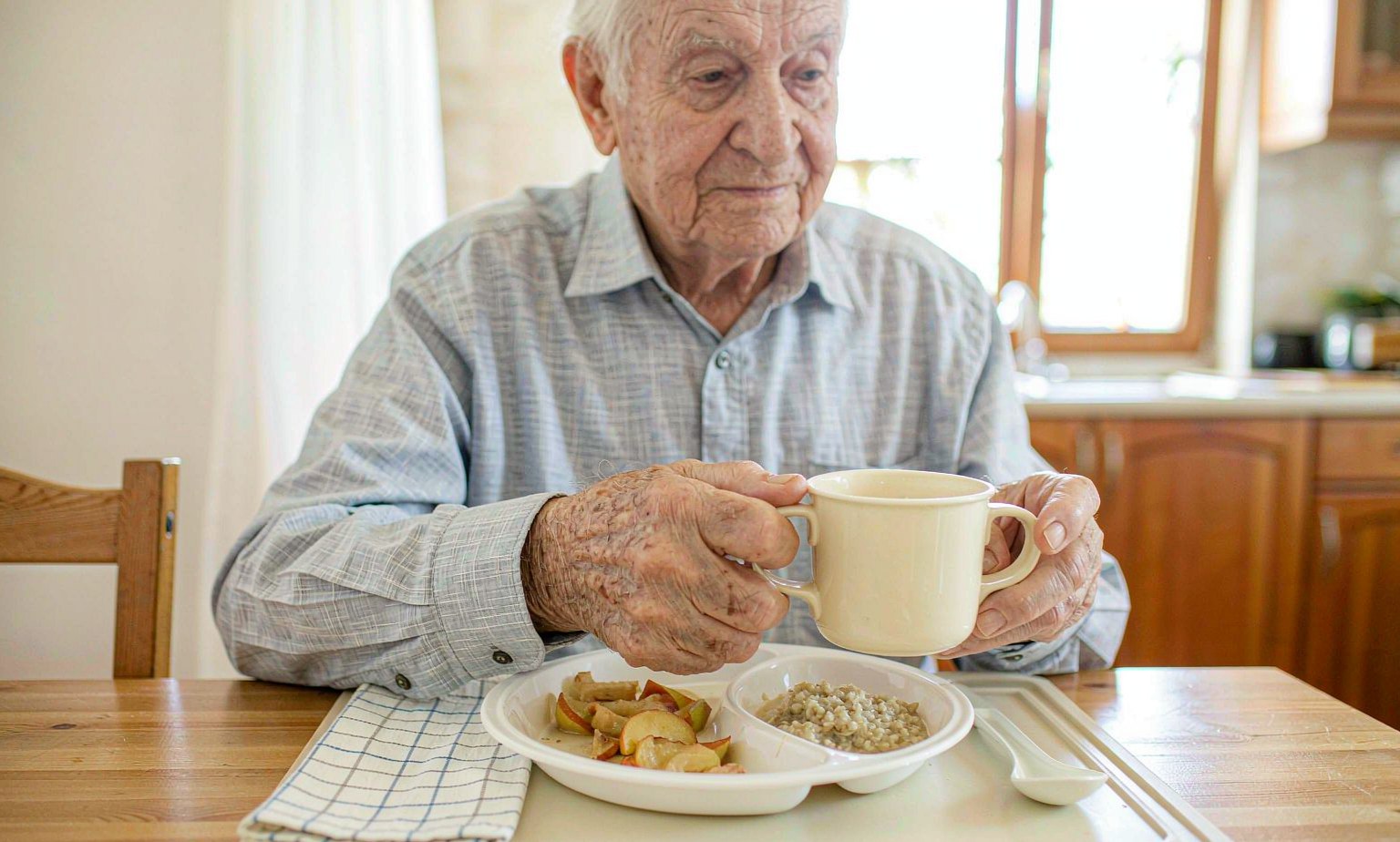
That is redrawing the equipment list room by room. In the bedroom, the case for a care bed with independent back and leg motors, a bed rail that folds flat for transfers and a pressure relief mattress is that none of them require consent, connectivity or a subscription, while a bed exit alarm and an emergency call button add the alert layer on top. In the bathroom, a grab bar, a shower chair, a non-slip bath mat, a raised toilet seat and a commode chair do much of what a camera would attempt at a fraction of the liability. At the table, adaptive utensils, a non-slip plate and a two-handled cup let a caregiver step away while a discharged patient keeps eating. At the door, a rollator, a walking frame or a lightweight wheelchair decide whether the next assessment happens at home or on a ward.
Two judgments follow for anyone sourcing assistive devices and other age-friendly products into these programmes. The first is that no camera has become a specification line that must be documented rather than a marketing phrase: a fall detection radar or smart mattress sold into a publicly funded contract now needs an on-device processing statement, a retention schedule and a data-flow sheet a procurement officer can file beside the test report, and suppliers who arrive with only a brochure will lose to those who arrive with the paperwork. The second is that spending across the silver economy is splitting into two tracks. Passive hardware carries almost no data liability, so grab bars, bed rails, commodes and shower chairs get bought first and in volume, which favours factories that can ship assembled, wipe-clean units on pallets. Monitoring follows as a subscription, with market researchers pricing fall detection hardware between USD 20 and USD 200 a unit and monitoring at USD 19 to USD 30 a month; wearables still hold roughly 70% of that market even as radar grows fastest. For buyers weighing ageing in place against assisted living, the practical test for independent living is no longer which sensor is cleverest but which room can be made safe without generating a record that someone must defend. The supplier who can bundle a room kit and a sensor into one order, with documents for both, is the one who gets called again.
Yiwu Orange Light Future Technology keeps a close eye on global trends in elderly health. Specializing in age-friendly wellness products, we offer a range of mature solutions to support seniors' safety and health at home. We welcome inquiries and business discussions from all partners!
CATEGORIES
LATEST NEWS
CONTACT US
Name: Fannie
Mobile:+86 13375799060
Tel:+86 13375799060
Whatsapp:+86 13375799060
Email:fannie@ywolftech.com
Add:589 Longtan Road,Jinhua City Zhejiang Province China