
News
Neighbourhood Care Teams Rewrite Demand for Grab Bars and Care Beds
England's health and social care secretary set a target on 18 November that will be measured in equipment as much as in staff. Yvette Cooper told the King's Fund annual conference that neighbourhood support teams would cover 1.8 million of the country's frailest residents, with at least 1% of the population, more than half a million people, enrolled by April 2027. Officials estimate the earlier intervention could remove around 4.3 million emergency bed days a year, worth more than GBP 1 billion in net savings, on the logic that 3% to 5% of the population consumes about 70% of emergency bed capacity.
The architecture was set out a week earlier in Liverpool, where care minister Alison McGovern told the National Children and Adult Services Conference on 12 November that England will count 18 million people aged 65 and over by 2050, more than 10 million past 75, and twice today's number past 85. Councils are carrying the bill: nearly a fifth have needed exceptional financial support in the past five years, 36 of them this year. The government has pencilled in an extra GBP 4.6 billion for local authorities in 2028-29, and a shift to neighbourhood commissioning, in which one or two providers serve a small patch. A Bristol study of six providers found that redrawing rounds into geographic zones could deliver identical care with 35% less staff time and 65% less driving. The same week, New South Wales committed AUD 259 million to a hospital-at-home service meant to treat 76,000 patients a year, the equivalent of 700 beds. Both governments are betting that ageing in place costs less than long-term care, if the house can be made to work.
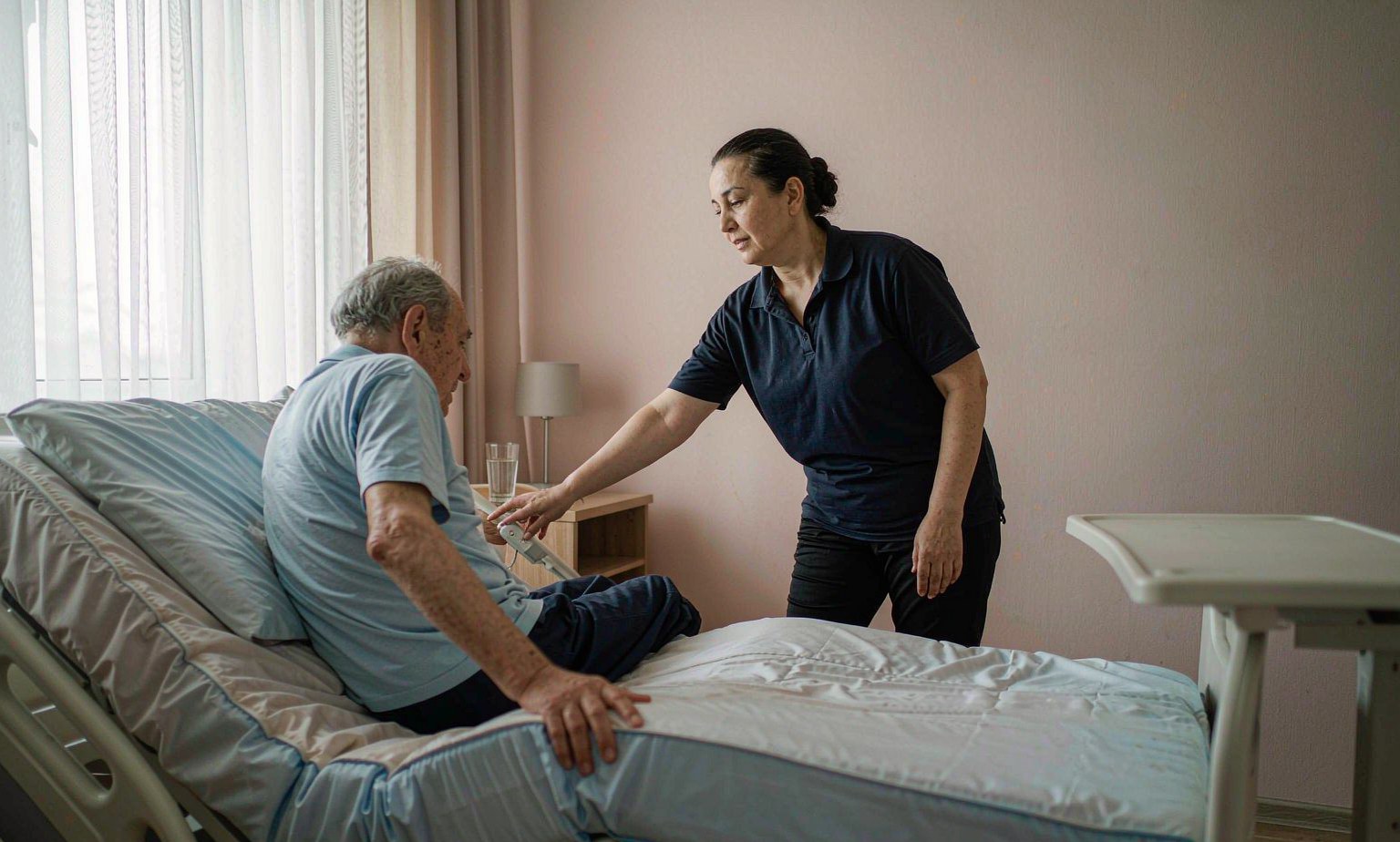
Together they change what a home care visit can carry. A worker with thirty minutes and no second pair of hands cannot install anything, so goods must arrive assembled, fold with one hand and survive being wiped down four to six times a day. The design brief is no longer independent living, it is a single round. In the bathroom that points to a shower chair with tool-free legs, a grab bar with a documented pull-out rating, a raised toilet seat that clips on without a wrench and a commode chair light enough to shift between rooms. In the bedroom it means care beds whose motors a fitter can swap in twenty minutes, a bed rail that folds flat for transfers, and a pressure relief mattress that does not need a pump the family must learn to operate.
The clinical side leans on data. Every enrolled patient is promised a tailored care plan, scheduled reviews and, where appropriate, remote patient monitoring, which turns the bedroom into a measurement point: a fall detection radar on the ceiling, an emergency call button within reach of the pillow, a smart mattress logging overnight movement for a caregiver checking a phone at three in the morning. That is where spending is heading. Market Lens IQ puts global home medical equipment at USD 54.35 billion in 2026, rising to USD 77.07 billion by 2031 at 7.24% a year; SNS Insider separately projects the mobility aids market expanding 9.12% a year to 2035. The quieter volume sits at the table, where a two-handled cup, adaptive utensils, a non-slip plate and a divided plate decide whether a discharged patient eats unaided, and at the door, where a rollator or a walking frame determines whether the next review happens in a chair or in an ambulance.
Britain's buying decisions will be rehearsed in public within days. The Occupational Therapy Show runs at Birmingham's NEC on 25 and 26 November with more than 200 suppliers and backing from the Royal College of Occupational Therapists and the British Healthcare Trades Association. Abacus Specialist Bathroom Solutions is using the event to launch a compact platform bath at 1,700mm by 750mm, with 250mm of immersion, a 165kg safe working load, obstruction sensors and battery backup, a specification for therapists who must justify a purchase to a finance officer. The specification has become the sales document. Load ratings, wipe-clean surfaces, spare-part lead times and a cleaning protocol that survives a commissioning audit now carry more weight in a tender than a lower unit price.
Two judgments follow for suppliers of assistive devices into these systems. The first is that demand will be lumpy. Neighbourhood commissioning concentrates volume into a handful of contracts awarded on service terms, so a factory that retools around a single order of care beds is exposed when the contract moves; steadier volume sits in the repeatable items every discharge kit needs, from grab bars and shower chairs to commode chairs and transfer benches. The second is that certification is no longer a formality. A supplier quoting into a publicly funded home care package should expect ISO 13485 documentation, CE marking wherever the item is a medical device, batch traceability and packaging built for palletised delivery rather than a showroom. Buyers increasingly ask for a cost per household per year, not a price per container, which rewards the supplier who can ship a spare bracket in year four over the one who wins the first quote.
Yiwu Orange Light Future Technology keeps a close eye on global trends in elderly health. Specializing in age-friendly wellness products, we offer a range of mature solutions to support seniors' safety and health at home. We welcome inquiries and business discussions from all partners!
RELATED NEWS
- Lightweight Upright Exoskeleton Walking Device Secures Medical Device Certificat
- International Symposium on Age-Friendly Assistive Devices: Helping Mobility-Impa
- Longevity Research Fuels Global Age-Friendly Products for Independent Senior Liv
- Age‑Friendly Mobility: Securing Independent Living for Globally Ageing Populatio
- Overseas Attention Drawn to Wheelchair Safety: Proper Operation Cuts Senior Acci
CATEGORIES
LATEST NEWS
CONTACT US
Name: Fannie
Mobile:+86 13375799060
Tel:+86 13375799060
Whatsapp:+86 13375799060
Email:fannie@ywolftech.com
Add:589 Longtan Road,Jinhua City Zhejiang Province China