
News
Fall Detection Radar Moves Into Senior Homes as Grab Bars Lag Behind
Only 18 percent of American homes have a grab bar in the bathroom, and in households where someone uses a wheelchair, walker or other mobility device, 62 percent still have none, according to housing data compiled by the U.S. Census Bureau. The same research puts the share of disabled older adults living without bathroom grab bars at 61 percent. Those figures have barely moved even as fall detection radar, smart care beds and remote patient monitoring arrive in the same homes, and the contrast now defines the market: monitoring is spreading far faster than the hardware that actually prevents a fall.
Installs have accelerated this month. LG Uplus is piloting its AI Building Net platform at Shinhan Life Care's Solache Home Misa in Hanam, where radar beside each bed turns a light at the nursing station red when a resident falls and pushes the room number to staff tablets. The operator projects Korea's senior market at 168 trillion won by 2030 and estimates one service robot absorbs a staff member's workload in a 200-resident building, worth about 1.5 percent of annual operating profit. In Shanghai's Fengxian district, 114 households of seniors living alone received bathroom radar detectors, bedside pull-cord alarms and voice call units this month; Yangquan in Shanxi fitted a first dozen homes with millimetre-wave radar, and a pilot in Shenzhen's Longgang district hides sensors inside wall tiles so the equipment cannot be seen but the protection can be felt.
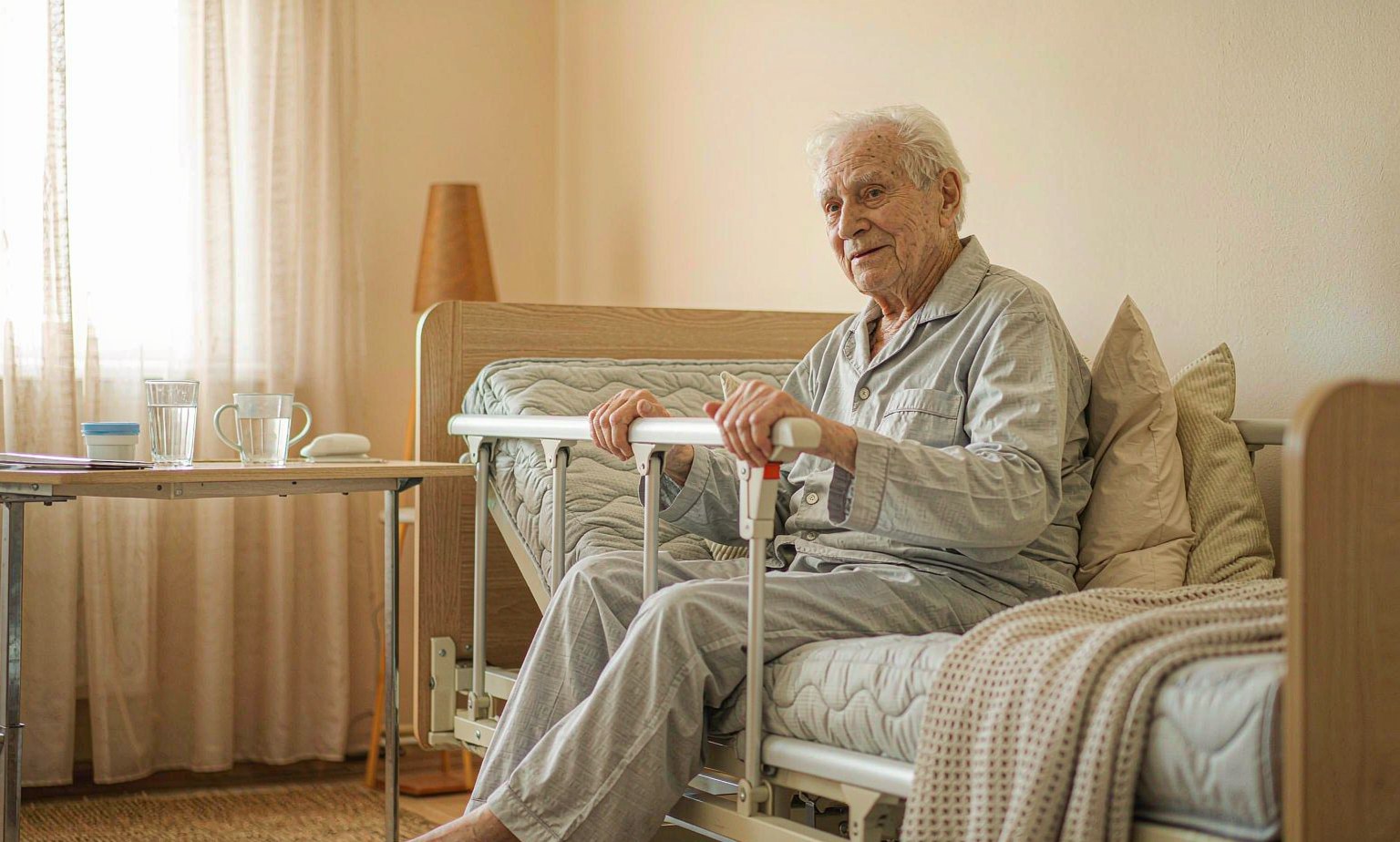
The reasoning is sound: most falls happen within a few steps of the bed, the toilet or the shower. But a radar that reports a fall is an outcome device; it does not stop one. What stops one is duller, cheaper and installs in an afternoon: a grab bar anchored into studs beside the toilet and inside the shower, a non-slip bath mat, a shower chair that removes the need to stand on wet tiles, a raised toilet seat or commode chair that shortens the distance between sitting and standing, and a bed rail that gives a hand something to hold at night. The same logic runs through the bedroom, where an adjustable bed or electric nursing bed with a pressure relief mattress and positioning pillow cuts both fall risk and the labour of repositioning, and through the dining table, where adaptive utensils, weighted cutlery and a two-handled cup keep a meal independent after grip strength has gone. Outside, a rollator walker and a folding lightweight wheelchair decide whether the front door gets used at all.
The figures describe a distribution problem more than an innovation problem. An installed grab bar runs $100 to $400 in the United States, a raised toilet seat $30 to $200 and a shower chair $40 to $300, yet Harvard's Joint Center for Housing Studies finds only 10 percent of homeowners aged 65 to 79, and 14 percent of those 80 and older, have completed any accessibility-related improvement. The median American house predates step-free design, and remodelling usually follows a hospital discharge rather than preceding it. A consumer survey in China finds the same hesitation from the other side: 30.2 percent of seniors resist a grab bar because it makes them feel like patients, though 63.6 percent name bathroom and corridor rails as their top priority. That is a design brief. A shower chair shaped like a leisure chair, rails matched to the tiles, a raised seat that reads as an ordinary fixture — these get installed in homes that refuse anything clinical.
Forecasts carry the same imbalance. Household assistive devices for the elderly are tracking 10.2 percent compound annual growth through 2032, with online channels at 56 percent of sales in 2026 and Asia-Pacific the fastest region at 12.4 percent, while North America and Europe together absorb over 60 percent of global shipments by value, according to UN Comtrade data. Basic mobility aids remain a Chinese export strength — canes, walkers, shower chairs, commode chairs — while radar modules, control boards and wireless gateways come from a far more concentrated electronics base. That split matters: a distributor bundling a fall detection radar with a grab bar range is buying from two unrelated supply chains and lead times, and the sensor half carries component and tariff exposure that moulded plastic never did. Suppliers likely to win the next two years will ship a coordinated room kit — rails, seating, bedding and a gateway — on one purchase order instead of four.
Buying behaviour is shifting with it. Care home groups and home care agencies ask for interoperability documentation rather than accuracy figures alone, because a sensor that cannot hand an alert to the nurse-call system or a family's phone adds cost without adding safety. Occupational therapy teams want adjustment ranges and load limits in writing. Retail buyers want shelf-ready packaging and spares for what fails first: rubber tips, suction pads, brake handles. With long-term care operators short of staff, the deciding argument is labour saved per shift rather than features per unit, which favours suppliers able to pair an electric nursing bed or lift chair with a monitoring layer and a service agreement, under their own label or through an OEM or ODM program.
Yiwu Orange Light Future Technology keeps a close eye on global trends in elderly health. Specializing in age-friendly wellness products, we offer a range of mature solutions to support seniors' safety and health at home. We welcome inquiries and business discussions from all partners!
RELATED NEWS
- Telemedicine Innovations Deliver Continuous Health Monitoring for Homebound Olde
- Global Aging Summit Reaches Consensus: Prioritize Geriatric Chronic Disease Prev
- Popular in Europe: Cycling Without Age Promotes Healthy Travel for Older People
- Global Consensus on Healthy Aging: Strength, Aerobic and Balance Training Form t
- Global Focus on Healthy Ageing and Elderly Healthcare
CATEGORIES
LATEST NEWS
CONTACT US
Name: Fannie
Mobile:+86 13375799060
Tel:+86 13375799060
Whatsapp:+86 13375799060
Email:fannie@ywolftech.com
Add:589 Longtan Road,Jinhua City Zhejiang Province China