
News
India's 230 Million Seniors Push Elderly Care Products Toward Home Use
India's population aged 60 and over is projected to reach about 230 million by 2036, double the 104 million counted in the 2011 census, and spending is following the demography. The country's elderly care products market was valued at USD 1.03 billion in 2025 and is forecast to reach USD 1.85 billion by 2034, yet the more instructive figure sits underneath it: home care accounted for 46.2 percent of that market, ahead of hospitals and institutions. That split turns a clinical supply story into a retail one, and it explains why so many new catalogues for elderly care products now open with bathroom and bedroom lines rather than hospital furniture.
The state is paying for part of that shift. Under India's Atal Vayo Abhyuday Yojana, the Rashtriya Vayoshri Yojana has distributed roughly 5.6 million assistive devices to more than 1.05 million seniors since 2017, and the programme funded 764 senior citizen homes and 17 mobile medicare units in the quarter to September 2026, with INR 77.98 crore released across 755 projects. A national dashboard lists 30,151 trained caregivers, and Kerala became the first Indian state to pass a comprehensive senior citizens law this year, with penalties of up to three years for neglect. Japan shows where the curve leads: a survey of more than 4,300 adults aged 55 to 75 by the Center for Retirement Research at Boston College found 65 percent would choose a care home that uses robots for some tasks, and would pay 8.3 percent more for it, with 70 percent preferring facilities that use lifting robots for transfers between bed, chair and toilet. Japan has subsidised those purchases since 2015, and by 2022 more than 70 percent of nursing homes used at least one. The trade gets to test the same propositions on a show floor this month, when MEDICA opens in Dusseldorf on 16 November with home care, consumables and hygiene occupying Halls 5, 6, 7a and 7.0.
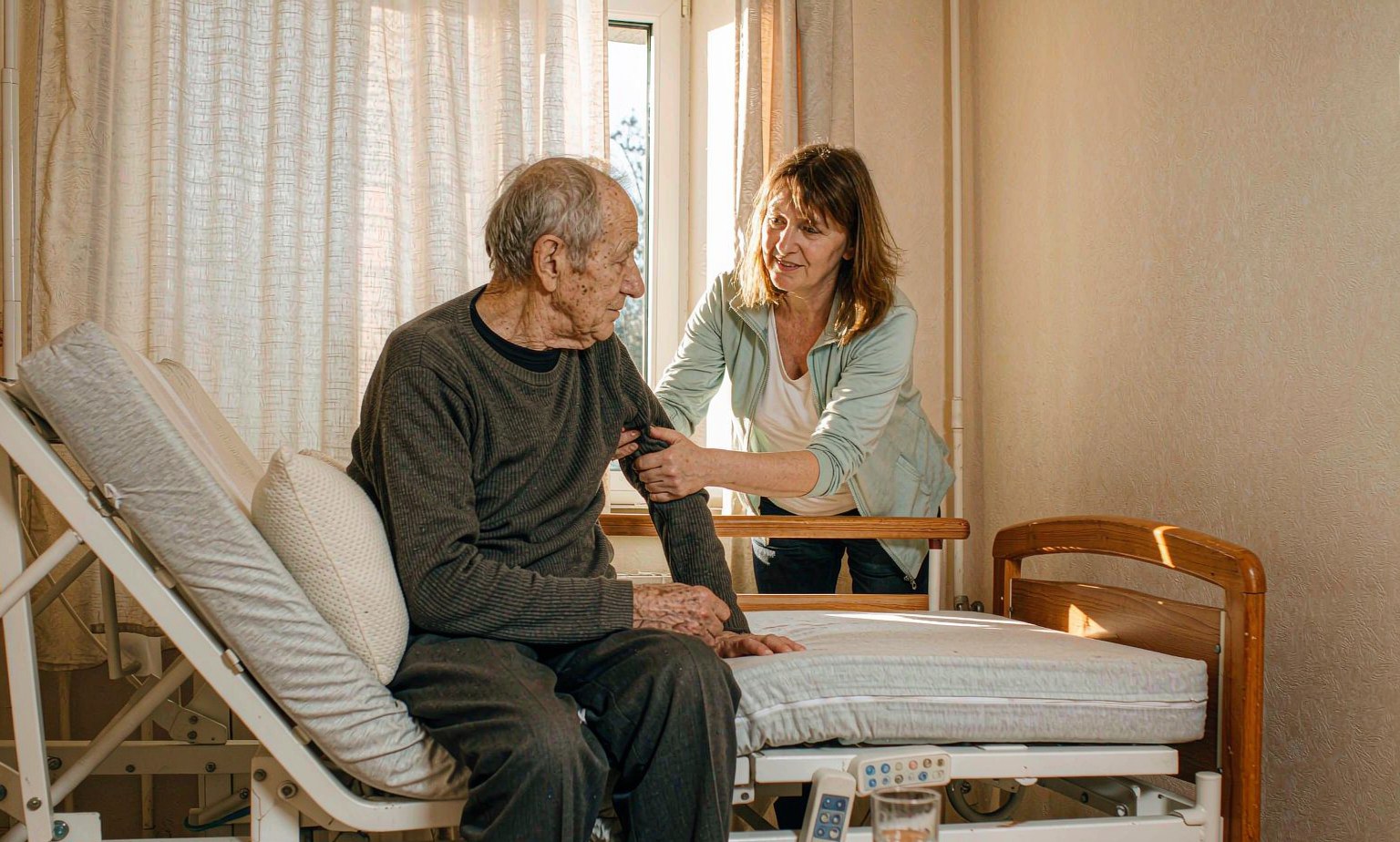
Read the demand room by room and the catalogue organises itself. The bathroom is the first purchase: a grab bar fixed beside the toilet and inside the shower, a non-slip bath mat, a shower chair or bath seat that removes the need to stand on wet tiles, and a raised toilet seat or commode chair that shortens the distance between sitting and standing. The bedroom comes next, where a bed rail or bed assist bar, an adjustable bed or electric nursing bed, a pressure relief mattress and a positioning pillow cover the hours when no caregiver is awake; a fall detection radar or bed exit alarm sits on top of that layer, not in place of it. At the table, adaptive utensils, weighted cutlery, a plate guard, a suction bowl and a two-handled cup keep eating independent once grip and coordination fade, while a pill organizer, a reacher grabber and a long-handled shoehorn handle the smaller tasks that decide whether someone manages alone. Getting out of the house still runs on a rollator walker, a walking stick, a folding lightweight wheelchair and, for longer distances, a mobility scooter.
For importers, the consequence is that a single-category catalogue has become a handicap. A distributor supplying Indian or Southeast Asian home care channels is now asked for one purchase order that covers a bathroom refit and a bedroom set-up together, because the end buyer is a family rather than a procurement department. That changes packaging and paperwork as much as product: retail-ready cartons with installation diagrams that survive translation, load ratings printed on the rail instead of buried in a manual, rubber tips and suction pads sold as line items, and a colour range that lets an age-friendly products range look specified rather than assembled.
The supply chain is splitting in two, and the split is where margin now sits. Mechanical items — rails, seating, commodes, non-slip surfaces, mobility aids — are moulded, welded and packed across Guangdong, Zhejiang and Jiangsu, compete mainly on tooling cost and freight density, and reward a supplier who can hold one price across a mixed container. Electronic items come from a far narrower component base, carry allocation and tariff risk, and need firmware support that most trading houses cannot staff. A factory claiming both under one roof is usually assembling one and buying the other, which is worth establishing before a buyer commits to a two-year OEM or ODM programme.
Two cautions follow. The forecasts are directional rather than bankable: WHO expects the global population aged 60 and over to rise from 1.1 billion in 2023 to 1.4 billion by 2030, but the purchasing power behind those people is deeply uneven, and a silver economy expanding at six or seven percent a year does not absorb premium pricing. The categories travelling best across Asia are mid-priced and mechanically simple — a commode chair costing less than a week of home nursing, a shower chair that fits a 600mm bathroom. Second, public device schemes reward standardisation: when a state programme buys in bulk it buys to a specification sheet, so suppliers able to document load limits, materials and test methods take tenders that retail buyers never see.
Yiwu Orange Light Future Technology keeps a close eye on global trends in elderly health. Specializing in age-friendly wellness products, we offer a range of mature solutions to support seniors' safety and health at home. We welcome inquiries and business discussions from all partners!
RELATED NEWS
- Exploring Overseas Silver Market, All-in-One Geriatric Wellness Solutions Sell W
- Multiple nations promote "nature‑based social programs" to reduce loneliness in
- Popular in Europe: Cycling Without Age Promotes Healthy Travel for Older People
- The Rise of Global Silver Consumption: Adults Over 60 Represent Nearly 30% of Wo
- Guarding Seniors’ Every Step: Classifications & Adapted Functions of Walking Aid
CATEGORIES
LATEST NEWS
CONTACT US
Name: Fannie
Mobile:+86 13375799060
Tel:+86 13375799060
Whatsapp:+86 13375799060
Email:fannie@ywolftech.com
Add:589 Longtan Road,Jinhua City Zhejiang Province China