
News
CIIE and Canton Fair Shift Age-Friendly Products to Self-Purchase
Three trade floors in three weeks have arrived at the same brief. The 140th Canton Fair ran its third phase in Guangzhou in early November, the ninth China International Import Expo opened in Shanghai on 5 November, and MEDICA begins in Dusseldorf on 16 November with integrated care, rehabilitation and home care written into its programme. Across all three, the instruction is less about category than sequence: an age-friendly product now has to let the user finish the action alone, with the caregiver counted as backup rather than as the intended operator. The pressure behind it is measurable. The World Health Organization puts the number of people needing at least one assistive product above 2.5 billion, projects roughly 3.5 billion by 2050, and reports access as low as 3 percent in some low-income countries against 90 percent in high-income ones.
Shanghai made that argument in hardware. Panasonic arranged a seated shower beside fixed grab bars and a smart care bed whose four motors move head, back, hip and leg sections separately, then added a water-leak sensor and an emergency call button, so washing, standing up and leaving bed each need one pair of hands. Otis fitted a lift with large buttons, handrails and safety sensors as standard, not options. Sonova's Asia premiere was a third-generation AI hearing aid 25 percent smaller than its predecessor and priced lower, a consumer-electronics curve, not a medical one: roughly 220 million people in China live with hearing loss, prevalence among the over-60s approaches 45 percent, and hearing aid use in that group runs at 5 to 6 percent against 30 to 40 percent in Europe and North America. Guangzhou told the supply-side version, with rehabilitation robots and AI sleep apnoea machines drawing overseas buyers, and Chinese medical device exports reaching USD 42.318 billion in January-September 2026, up 14.38 percent year on year. MEDICA will show rehabilitation exoskeletons beside ward-level fall detection.
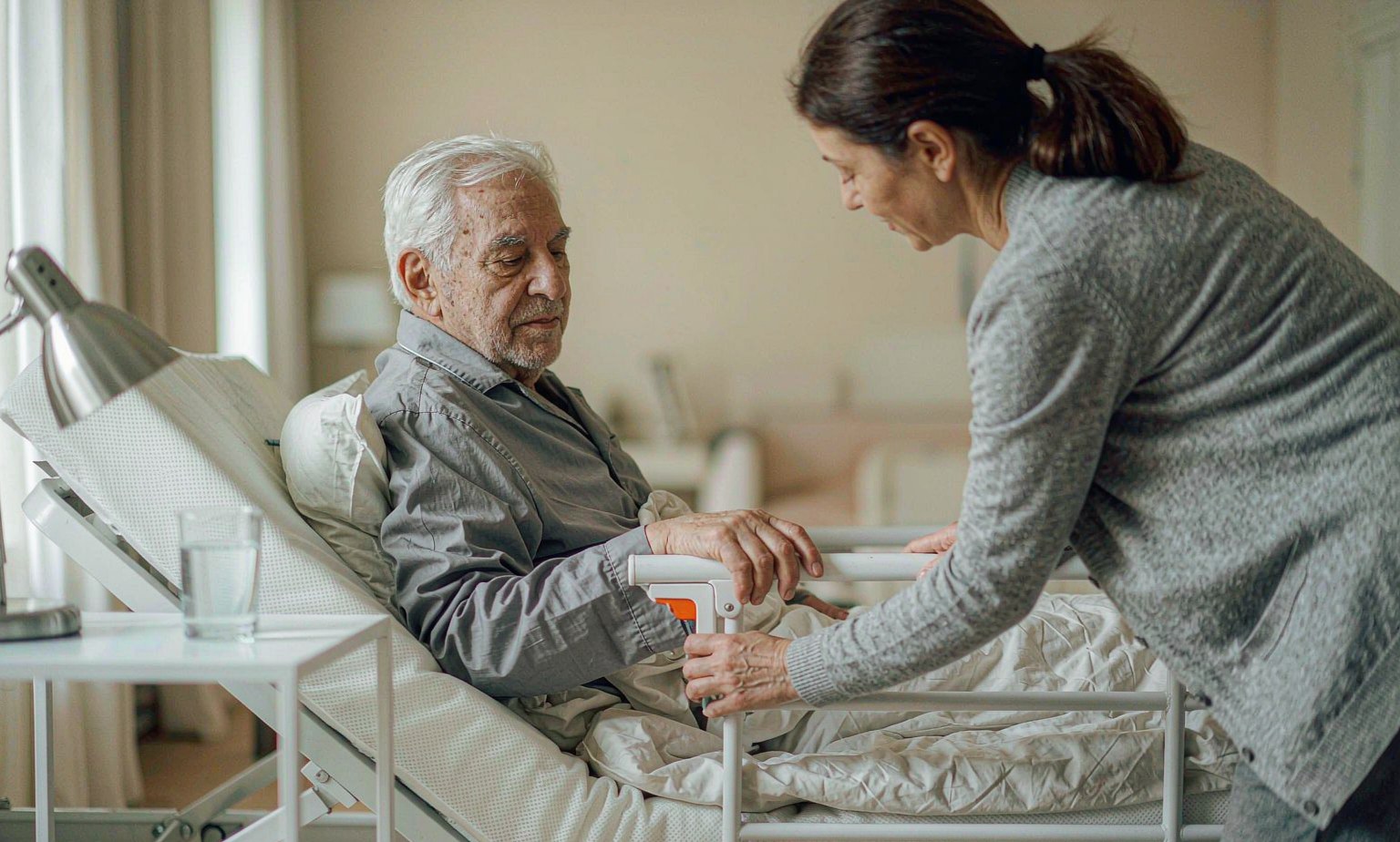
The numbers explain the crowds. China's disease control authority puts falls among older people at 40 million or more a year, half of them indoors, and research cited in Shanghai estimated that structured renovation can cut fall incidence by up to 40 percent, with rails alone cutting fall injuries some 39 percent. The base is thin: 2.24 million households had completed subsidised retrofits by the end of 2025 and urban penetration is under 6 percent, against a population aged 60 and over of 323.38 million, or 23.0 percent of the country, and a silver economy that passed CNY 9 trillion in 2025, heading for 9.8 trillion this year. Europe arrives at the same arithmetic from the policy side, where 53 countries adopted a WHO healthy-longevity strategy on 29 October that treats functional ability, the fit between a person's capacity and their surroundings, as the outcome worth measuring.
Follow that logic through a house and the catalogue sorts itself. The bathroom absorbs the first spend, because wet tiles and low seats produce most indoor falls: a shower chair or bath seat that removes the need to stand, a grab bar anchored into studs beside the toilet and inside the shower, a non-slip bath mat, a raised toilet seat or commode chair that shortens the sit-to-stand distance, and a bath lift where stepping over a rim is no longer safe. The bedroom carries the night shift, where an adjustable bed or electric nursing bed with a pressure relief mattress, a bed rail and a positioning pillow cut fall risk and repositioning labour at once, with a fall detection radar or bed exit alarm layered on top of the rails rather than substituted for them. At the table, adaptive utensils, weighted cutlery, a plate guard and a two-handled cup keep eating independent once grip fades, while a pill organizer and a reacher grabber cover the small tasks that decide whether a morning works alone. The front door still depends on a rollator walker, a walking stick, a folding lightweight wheelchair and a mobility scooter for longer trips.
For buyers, the person signing off on a purchase has changed. When the user buys, the objection stops being clinical and becomes social: a rail that reads as hospital equipment does not get installed, which is why colour matching, softer radii and fittings flush with tile now matter as much as load ratings. That pushes age-friendly products out of the medical aisle and into home improvement and general retail, where the rival on the shelf is a kettle rather than a commode, and where the carton has to explain installation in pictures instead of a manual.
The supply chain consequence is more SKUs at lower volume. A distributor that once ordered one container of elderly care products now wants a mixed load: bathroom line, bedroom line, dining aids, each in two or three colours, with retail-ready cartons and a mounting kit in the box. For an OEM or ODM manufacturer that means shorter runs, tighter control of packaging and documentation that survives translation, and real after-sales support for anything carrying a battery or a sensor, because a health monitoring device that fails in a customer's home costs the brand more than the unit was worth.
Yiwu Orange Light Future Technology keeps a close eye on global trends in elderly health. Specializing in age-friendly wellness products, we offer a range of mature solutions to support seniors' safety and health at home. We welcome inquiries and business discussions from all partners!
RELATED NEWS
- Services for Older Adults Living at Home
- Delayed Retirement Trend: A Look at Overseas Seniors Returning to Work
- Germany’s Community Elderly Care Model: Neighborhood Mutual Aid Combined with Re
- Healthy Longevity Initiative: Investing in Senior Health to Unlock Dividends of
- Widened Anti-Slip Shower Chairs – Thoughtful Bathroom Safety Gear for Elderly Ba
CATEGORIES
LATEST NEWS
CONTACT US
Name: Fannie
Mobile:+86 13375799060
Tel:+86 13375799060
Whatsapp:+86 13375799060
Email:fannie@ywolftech.com
Add:589 Longtan Road,Jinhua City Zhejiang Province China