
News
Germany's Care Reform Pushes Shower Chairs and Bed Rails Into Retail
Germany's long-term care overhaul reached the Bundesrat on 20 November, and the clause that should worry suppliers is not the contribution rate. The bill removes the €131 monthly relief allowance that households in care grade one can currently claim against everyday help, lifts the assessment thresholds for grades one to three, and folds separate home-care benefits into block budgets. Germany counted 5.7 million people needing care in December 2023, and 86 percent of them were living at home. Take away a reimbursement at the very start of that journey and the first thing a family buys is rarely a medical device; it is a shower chair, a bed rail or a raised toilet seat paid for on a card. That shift in who pays is already redrawing what overseas buyers put on their order sheets.
The money explains the urgency. The cabinet approved the bill on 30 September and the Bundestag held a first reading on 5 November; a parliamentary answer published on 19 November, paper 21/9239, confirmed that two of the harshest draft proposals were dropped before the cabinet text: halving the allowance for people newly entering grades two and three, and trimming pension credits for unpaid family carers. What survived is a package Berlin expects to save or raise €6.25 billion next year. From January 2027 the childless surcharge rises 0.3 points to 0.9 percent on a 3.6 percent base, the assessment ceiling gains €300, and grades two to five get a bridging budget of up to €2,285 a year instead of a standalone respite entitlement. Berlin's own arithmetic adds 11,500 people to social assistance by 2028 and €1.35 billion of cost to municipalities already €20.1 billion in deficit in the first half of 2026. None of it is law yet, which is why order books are already being set against it.
Where those people live decides which products move. Of the 11,250 full inpatient homes counted in 2023, the average holds 59 residents, 775,961 in all, while 15,549 outpatient services reach 1.1 million clients — an ambulatory sector larger by facility count than the residential one. Destatis projects 7.6 million people needing care by 2055. More than half of home cases run with no professional service at all, so a product needing a technician to fit it, or a manual nobody reads, does not get bought. Flat-pack assembly, tool-free brackets and pictogram instructions are commercial features in this market rather than packaging niceties, and they are the reason ageing in place in Germany looks less like a service subscription and more like a shelf of assistive devices.
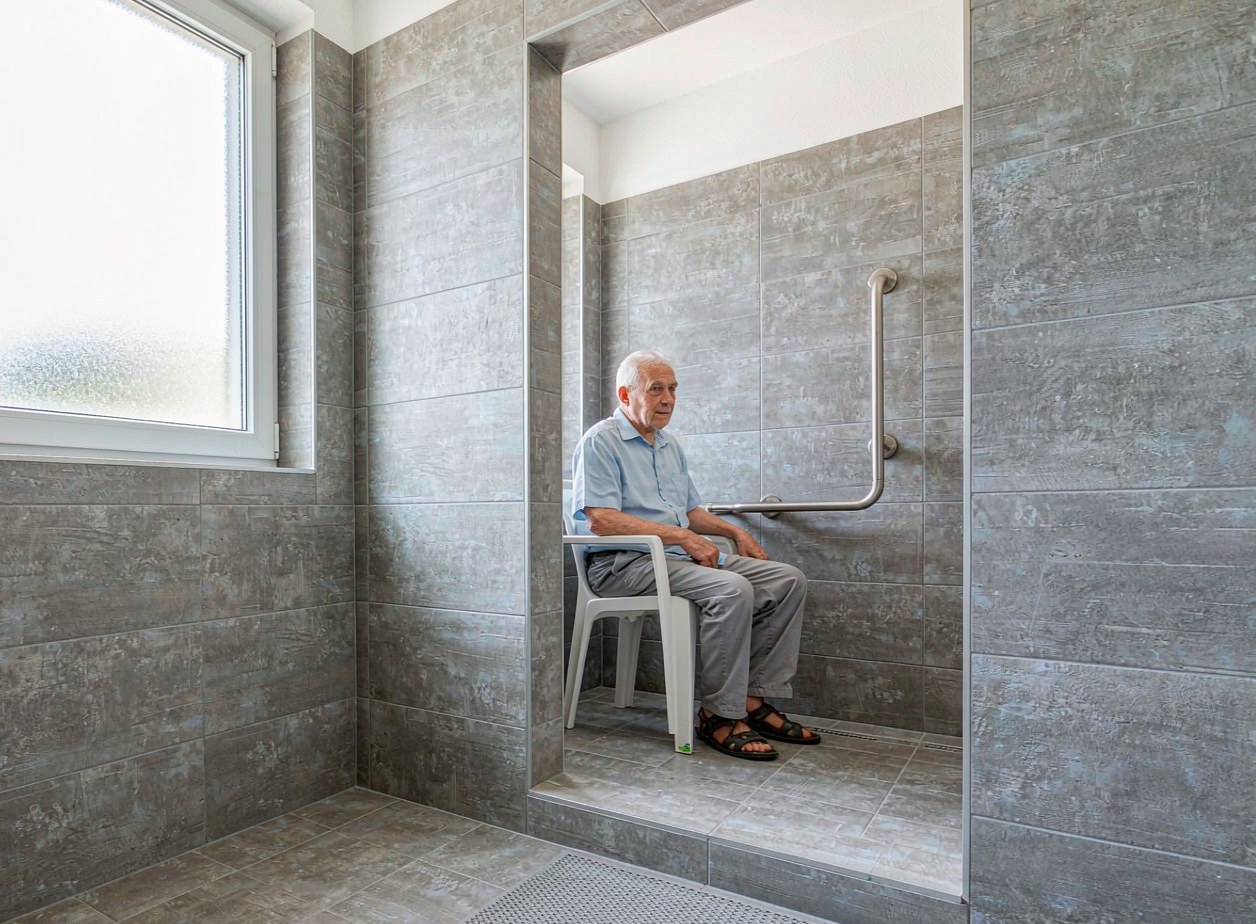
The specification work happens room by room. A bathroom in a grade-one or grade-two household usually needs a shower chair or bath seat that clears a 90 cm tray, a grab bar anchored into masonry rather than plasterboard, a non-slip bath mat, and a raised toilet seat or toilet frame where a full commode chair reads as too institutional. In the bedroom the entry point is a bed rail or bed assist bar clamped to an existing adjustable bed, then a pressure relief mattress and an overbed table once someone spends the day there. At the table a divided plate, a two-handled cup and adaptive utensils cost less than one home visit and keep a person eating without a caregiver standing over them. For mobility a rollator or walking frame with a seat suits a pavement-and-tram routine better than a transport wheelchair, and a lift chair absorbs the transfer that most often ends in a fall.
The United States is moving the other way on paper. The CY2027 home health final rule, released on 4 November, adds 2.4 percent, about $415 million, to Medicare home health spending, lifts the 30-day episode rate to $2,092.69 from $2,038.22, keeps a temporary 3 percent cut and extends coverage to home infusion pumps from April 2027. Agencies stay the buyer there. That is why one factory ships two products from the same line: a bare device with a billing sheet for America, a retail-ready carton with a shelf price for Germany. Suppliers treating the European catalogue as a translated American one lose on both sides: a family comparing three shower chairs in a shop judges finish, weight and returns policy, not a reimbursement code.
The sourcing calendar has caught up with that reality. The 12th Guangzhou International Senior Care Industry Exhibition opens on 26 November for three days at the Poly World Trade Expo Pavilion, with more than 600 exhibitors, roughly 10,000 products across eight zones and a stated 22,000 square metres of floor. The category mix carries the message: bathroom safety, bedroom equipment and dining aids now share halls with robots and monitoring hardware, and the exhibitors pulling European inquiries quote a matched bathroom set at one minimum order instead of a single grab bar at container price. For buyers, the test this quarter is whether a wholesale supplier can put load ratings, salt-spray hours and carton dimensions in metric on the table before a sample ships. The silver economy is not short of age-friendly products; it is short of suppliers who can answer that question in one email.
Yiwu Orange Light Future Technology keeps a close eye on global trends in elderly health. Specializing in age-friendly wellness products, we offer a range of mature solutions to support seniors' safety and health at home. We welcome inquiries and business discussions from all partners!
RELATED NEWS
- Global Consensus on Healthy Aging: Strength, Aerobic and Balance Training Form t
- Care Worker Shortage Turns Patient Lifts and Nursing Beds Into Staffing Strategy
- Era 3.0 of Wellness Residency: Abandon Superficial Sightseeing, Embrace Immersiv
- Ensure that all elderly people can benefit from the development of the silver ec
- As China tackles aging, elderly-care robots hit fast track
CATEGORIES
LATEST NEWS
CONTACT US
Name: Fannie
Mobile:+86 13375799060
Tel:+86 13375799060
Whatsapp:+86 13375799060
Email:fannie@ywolftech.com
Add:589 Longtan Road,Jinhua City Zhejiang Province China