
News
Global Silver Age Watch: Proper Use of Shower Chairs Safeguards Dignity of Disabled Elderly in Independent Bathing
Against the backdrop of deepening global population aging, bathing safety for mobility-impaired, semi-disabled and fully disabled elderly at home has become a key public health issue across numerous countries. The International Fall Prevention Alliance, together with senior care associations in Europe, the United States and Japan, recently jointly released a science popularization initiative. It stresses that standardized use of shower chairs can drastically lower the risk of bathroom injuries while preserving privacy and dignity for senior citizens to maintain personal hygiene independently.
Currently, shower chairs available on the market fall into two categories: wall-mounted and mobile, which can be selected according to bathroom size and the elderly user’s living habits. In general, the following criteria should be observed: the chair shall feature a smooth, rounded design without sharp edges, and its legs shall be fitted with anti-slip pads. When choosing a mobile shower chair, opt for models equipped with wheel locks, which must be fully engaged during bathing to prevent sliding. If seniors bathe on their own, a backrest-equipped shower chair is recommended to avoid fatigue from prolonged sitting. For users who rely on caregivers or cannot stand up and sit down repeatedly, care-type shower chairs with cut-out openings are the optimal choice.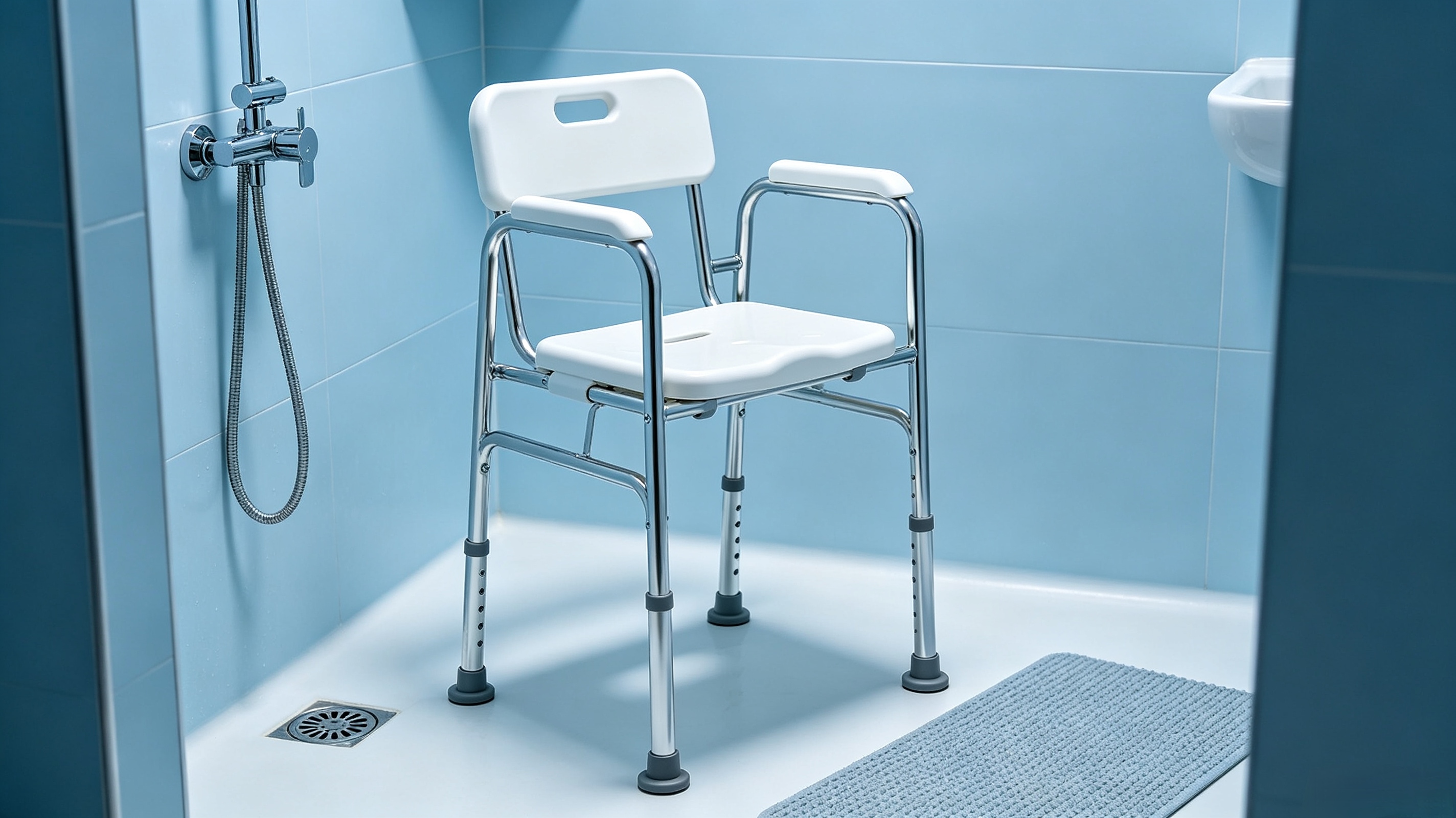
From an industrial perspective, the age-friendly assistive device market is undergoing rapid expansion.
In recent years, driven by the growing elderly population and rising consumption power, market demand for age-friendly products has kept surging. Forecasts from the China Research Center on Aging show that the market scale of elderly supplies will exceed 2 trillion RMB by 2025. Daily care products are witnessing robust growth, and multi-functional, safe shower chairs are expected to spur more enterprises to explore the silver economy market in depth.
The European Union has formulated unified standardized operating procedures for shower chairs based on ISO 17966 Assistive products for personal hygiene that support users — Requirements and test methods, paired with supporting care operation manuals issued by Japan’s Ministry of Health, Labour and Welfare (MHLW). Relevant training sessions are held regularly for community caregivers and family members of seniors. Professional care providers outline four core standardized operating steps: First, place the chair steadily on flat, anti-slip flooring inside the shower area; inspect all four anti-slip rubber foot caps for integrity and wear, then fully lock the height adjustment latches. Second, adjust seat height according to the user’s leg length to ensure their feet rest flat on the ground with knees naturally bent. Third, shift body weight sideways slowly when sitting down, gripping both armrests at all times; avoid twisting the body while bearing weight on a single leg. Fourth, remain seated throughout bathing; wipe water off hands and feet before standing, and rise slowly only after confirming no dizziness or weakness.
Many family members of severely disabled seniors shared that they previously had to assist with bathing the entire time out of fear of falls, which deprived the elderly of privacy and triggered inferiority and resistance. After switching to compliant shower chairs with armrests and backrests, mildly impaired seniors can complete bathing independently, while severely disabled users require less caregiver intervention and regain autonomy over personal hygiene. A person in charge of a community senior care program in Sweden pointed out that bathing is far more than a sanitary routine — it embodies the self-worth and personal dignity of the elderly. As a fundamental age-friendly assistive product, proper and safe use of shower chairs is a cornerstone of dignified aging at home.
Countries around the world are rolling out matching popularization programs simultaneously. In Japan, home care workers provide free on-site adjustment of bathing assistive devices covered under the national Long-Term Care Insurance scheme. Communities across European nations host hands-on bathroom safety workshops, while rehabilitation institutions in North America have incorporated shower chair operation into mandatory rehabilitation training courses. Global senior care industry experts note that despite fully implemented product safety standards, there remains a widespread gap in public education on standardized usage. Going forward, collaborations will be forged between age-friendly equipment manufacturers and medical institutions to launch multilingual illustrated guides and short video tutorials, bridging the final gap for safe aging in place.
Industry insiders add that safety details must be prioritized during both purchasing and daily use: regularly check the frame for rust and loose screws; refrain from placing heavy toiletries on the chair; install grab bars and anti-slip mats in bathrooms to build a complete safety system, so disabled seniors can retain dignity and independence during bathing under safe conditions.
Yiwu Orange Light Future Technology pays close attention to bathroom safety issues for the elderly. We offer a wide range of shower chair products and warmly welcome all inquiries and purchases!
RELATED NEWS
- Wheelchairs for the elderly
- Global Senior Care Development: Upgrading Services for Elderly Health
- Exploring Overseas Silver Market, All-in-One Geriatric Wellness Solutions Sell W
- International Congress of Nutrition: Customized Nutritional Diet Improves Gastro
- Smart Health Technologies Enter Communities to Build Full-Scenario Age-Friendly
CATEGORIES
LATEST NEWS
CONTACT US
Name: Fannie
Mobile:+86 13375799060
Tel:+86 13375799060
Whatsapp:+86 13375799060
Email:fannie@ywolftech.com
Add:589 Longtan Road,Jinhua City Zhejiang Province China