
News
Global Senior Care Demand Meets China's Age-Friendly Product Push
China's six ministries issued a joint package of measures on November 6 aimed at expanding consumption of age-friendly products, naming assistive devices, rehabilitation equipment and home-care supplies as priority categories. The move lands as the global population aged 60 and over climbs toward 2.1 billion by 2050, turning what was once a niche corner of medical devices into a mainstream consumer market for mobility aids, bathroom safety equipment and daily living products.
The Measures on Cultivating Diverse Scenarios to Promote Consumption of Age-Friendly Products, released by the Ministry of Civil Affairs together with the National Development and Reform Commission, the Ministry of Industry and Information Technology and three other departments, pushes age-friendly goods into home-based care, community service centres and dedicated online retail channels. The document also calls for accelerating embodied AI, large language models, brain-computer interfaces and exoskeletons into elderly care settings. Policy is following visible momentum on the exhibition floor. At the ninth China International Import Expo, which opened in Shanghai on November 5, exhibitors moved away from standalone gadget displays toward complete room solutions: a seated shower paired with fixed grab bars, electric care beds with four-motor positioning, water-leak sensors and fall detection radar. At the 140th Canton Fair earlier in the month, smart air-cushion mattress toppers and electric nursing beds drew heavy buyer traffic from Europe, Australia and Southeast Asia.
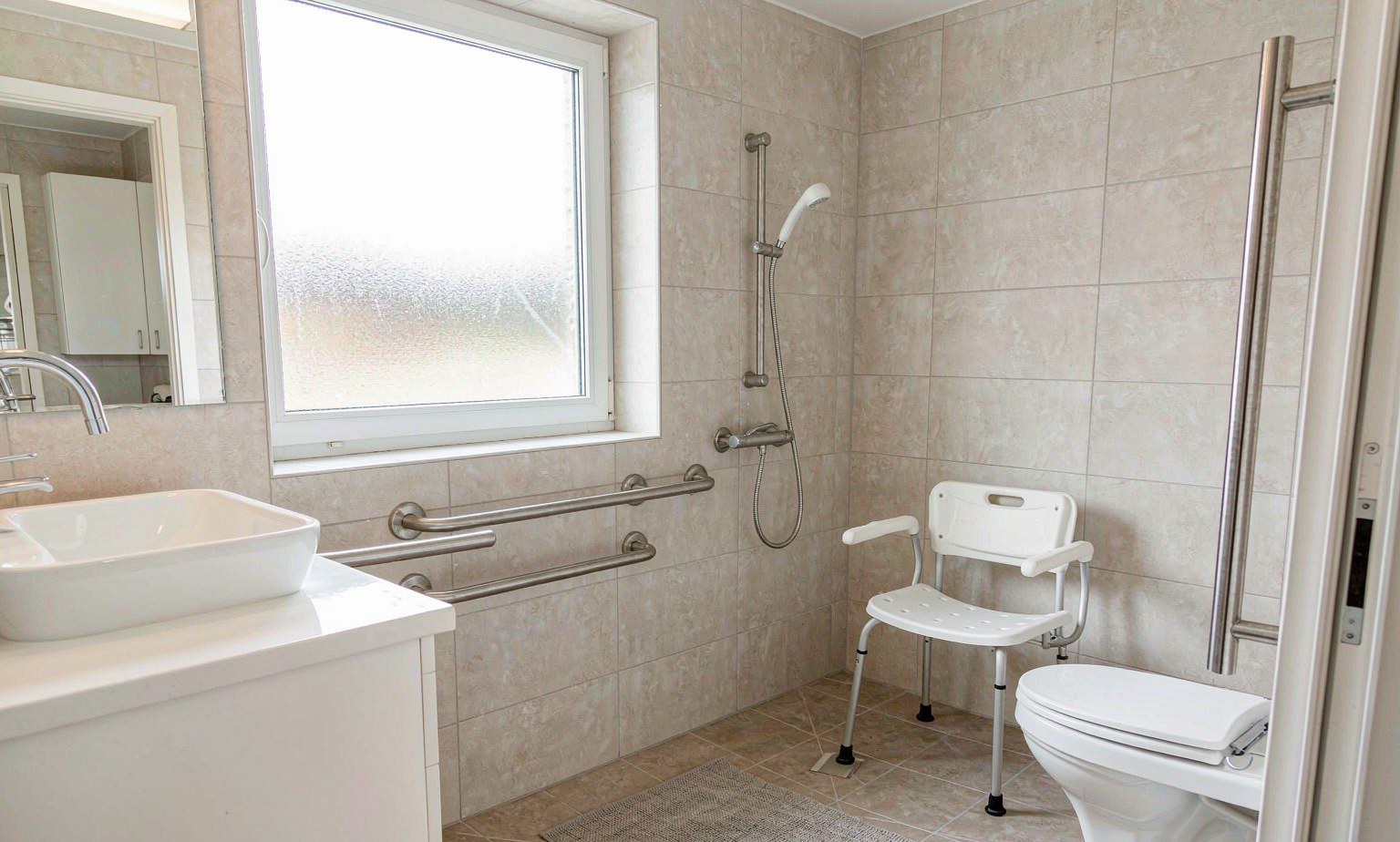
The shift matters because it changes what a care room is expected to contain. In the bathroom, a shower chair or bath seat only works when it is matched with a grab bar, a non-slip bath mat and a raised toilet seat or commode chair that let a senior sit, stand and transfer without a caregiver holding them upright. In the bedroom, bed rails and a bed assist bar now sit alongside adjustable care beds, pressure relief mattresses and positioning pillows that lower the risk of pressure sores during long bed rest. At the dining table, adaptive utensils, weighted cutlery, plate guards, suction bowls and two-handled cups restore independent eating for people with arthritis or limited grip, while a jar opener or one-handed peeler can decide whether someone still cooks for themselves. Outside the home, folding lightweight wheelchairs, rollator walkers, quad canes, walking frames and mobility scooters remain the backbone of independent living, with wheelchair cushions, anti-tip wheels and transfer boards completing the set.
China's own numbers explain the pace. People aged 60 and above reached 323 million by the end of 2025, roughly 23 percent of the population, and the silver economy was valued at about 9 trillion yuan, with official forecasts pointing to 30 trillion yuan by 2035. For overseas distributors and home-care chains, that scale translates into wider catalogues, faster tooling for OEM and ODM programs and shorter lead times on mixed container loads. Buyers are also asking for more than a single SKU: certification documentation, retail-ready packaging, spare parts availability and consistent colour matching across a bathroom safety line now weigh as heavily as unit price.
Demand is not China-only. Europe's 65-plus share keeps climbing, Japan already sells more adult diapers than baby diapers, and the United States is moving a generation of baby boomers into assisted living and ageing in place arrangements. Each market buys differently. German and Dutch importers lean toward certified rehabilitation equipment with clinical documentation, North American chains prioritise retail packaging and drop-ship readiness, while Southeast Asian and Middle Eastern buyers often start with high-volume basics such as walking sticks, shower stools and commode chairs before expanding into powered mobility.
Technology is entering the same catalogue. Fall detection radar, emergency call buttons, smart care beds and remote patient monitoring are being bundled with conventional grab bars and walking aids rather than sold as separate gadgets, and several exhibitors in Shanghai presented room-level packages that link lighting, bed position and bathroom sensors into a single response chain. For suppliers, the practical requirement is interoperability: a fall sensor that cannot talk to the care bed or to the family's phone adds cost without adding safety.
Yiwu Orange Light Future Technology keeps a close eye on global trends in elderly health. Specializing in age-friendly wellness products, we offer a range of mature solutions to support seniors' safety and health at home. We welcome inquiries and business discussions from all partners!
RELATED NEWS
- Asia-Pacific Joins Hands for Healthy Ageing: Primary Healthcare as the Core Driv
- Getting the Right Wheelchair Is Not Enough: Global Reflection on Hidden Health R
- Longevity Research Fuels Global Age-Friendly Products for Independent Senior Liv
- Develop Education for the Elderly, Enjoy Golden Years
- Longevity Era Challenge: Aligning Pensions and Healthcare with Population Ageing
CATEGORIES
LATEST NEWS
CONTACT US
Name: Fannie
Mobile:+86 13375799060
Tel:+86 13375799060
Whatsapp:+86 13375799060
Email:fannie@ywolftech.com
Add:589 Longtan Road,Jinhua City Zhejiang Province China