
News
Sensory and Non-Drug Therapies: New Dementia-Friendly Care Solutions Explored Globally
As global population ageing accelerates, dementia care has become a shared challenge for public health and elderly care sectors across many countries. While medications can relieve certain symptoms to some extent, they cannot reverse cognitive decline and carry risks of side effects. Against this backdrop, non-pharmacological therapies represented by sensory-based five-sense interventions are being trialled in communities, aged care facilities and home care settings overseas, emerging as a key area of exploration within dementia-friendly care frameworks.
Put simply, five-sense intervention uses gentle stimulation of sight, hearing, touch, smell and taste to awaken residual memories and emotional perception in older adults living with dementia. It helps calm agitation, ease anxiety, and improve sleep and emotional wellbeing. Unlike conventional care approaches, these therapies do not aim to restore cognitive function. Instead, they prioritise older people’s immediate feelings and respect their emotional expressions. In many dementia-friendly communities across Europe, care providers combine familiar old songs, vintage footage, natural plant scents, soft textiles and nostalgic snacks for activities. Many family caregivers report that once irritable or withdrawn older adults become willing to engage through sensory guidance, with a marked reduction in challenging behaviours such as aggression and wandering.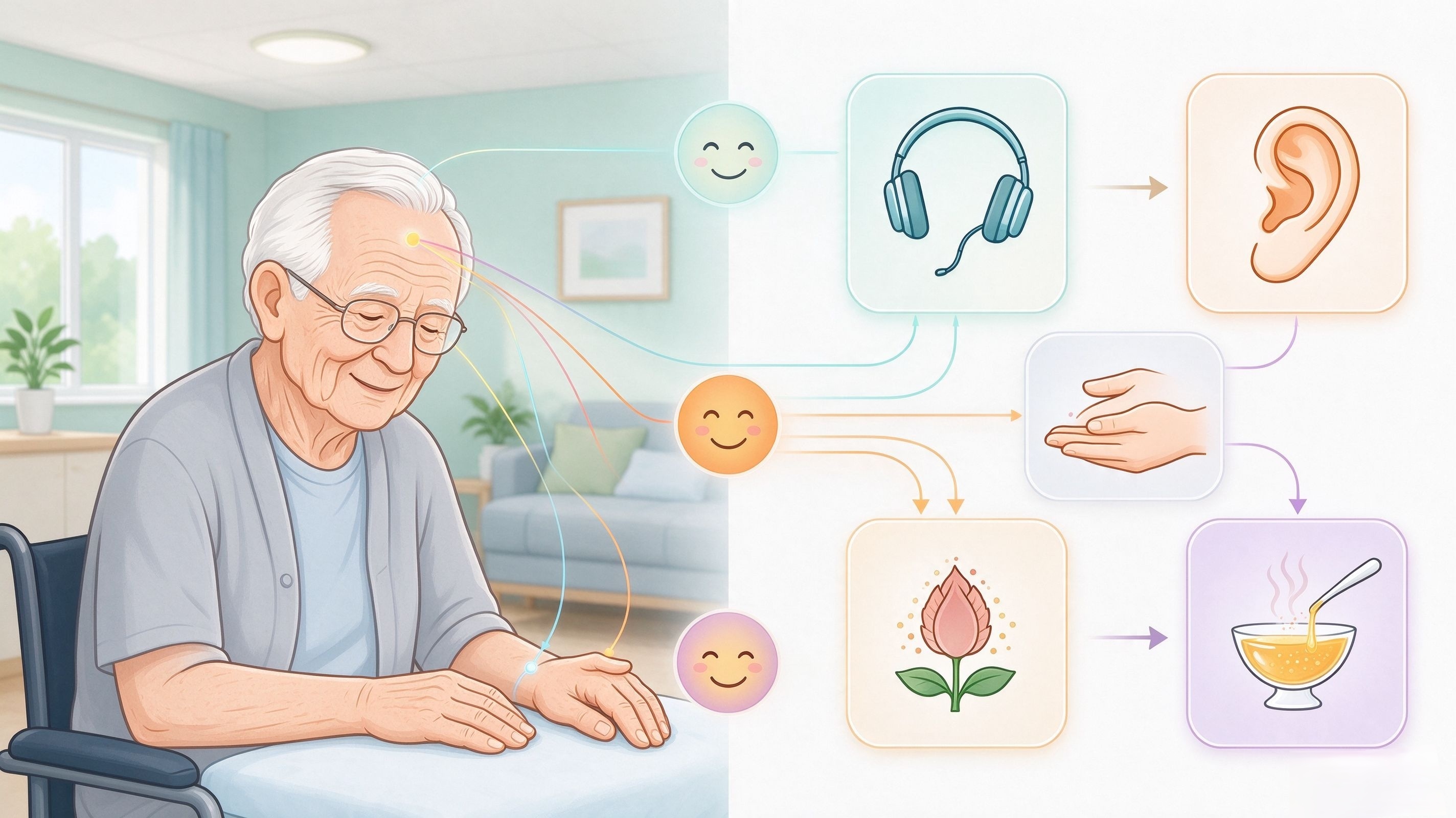
In countries including the United Kingdom, the Netherlands and Australia, non-pharmacological interventions have evolved from casual recreational activities into standardised care protocols. Some aged care facilities have built dedicated sensory gardens and reminiscence rooms with professionally designed colour schemes, lighting and aromas. Local governments also offer free training sessions for family carers and community volunteers, teaching simple five-sense care techniques that can be delivered at home to ease the burden of long-term care. Singapore has vigorously promoted dementia-friendly community initiatives in recent years, integrating music therapy and aromatherapy sensory interventions into community support services. This enables older adults with mild dementia to receive ongoing care in familiar surroundings without the need for early admission to specialised care facilities.
Researchers in the field note that non-pharmacological therapies complement rather than replace pharmaceutical treatment. They work best for people living with mild to moderate dementia, and are particularly effective for behavioural and psychological symptoms such as agitation, insomnia and low mood. Nevertheless, this model has limitations. Outcomes vary widely between individuals and are difficult to quantify uniformly. It also demands great patience and expertise from caregivers. Widespread adoption is hindered by shortages of trained instructors, cost concerns and inconsistent evaluation standards. Many research institutes are conducting long-term case tracking and data collection to develop replicable, assessable protocols.
A growing number of nations recognise that dementia care is not merely about physical support, but about preserving older adults’ dignity and quality of life. From public space adaptations and community caregiver training to the development of home-use sensory care kits, these efforts move steadily toward the goal of dementia-friendliness. This non-pharmacological care approach centred on five-sense interventions offers new insights for the global aged care industry: quality elderly care is not only about fighting illness, but about seeing the person behind the condition and accompanying them gently and compassionately through the journey of ageing.
Yiwu Orange Light Future Technology keeps a close eye on global trends in older adult health and specialises in age-friendly health products. Our portfolio of proven solutions supports safe and healthy ageing at home. Partners from all sectors are welcome for enquiries and business discussions!
RELATED NEWS
- As China tackles aging, elderly-care robots hit fast track
- New business opportunities in the silver economy: The elderly toy market is on t
- 30‑Year Harvard Cohort Research Reveals Few People Achieve Full Healthy Ageing
- Active Ageing: Seniors Rebuild Self-Worth via Travel and Social Connection
- Global Focus on Healthy Ageing and Elderly Healthcare
CATEGORIES
LATEST NEWS
CONTACT US
Name: Fannie
Mobile:+86 13375799060
Tel:+86 13375799060
Whatsapp:+86 13375799060
Email:fannie@ywolftech.com
Add:589 Longtan Road,Jinhua City Zhejiang Province China