
News
Age-Tech Adoption Gap Sends Buyers Back to Bed Rails and Commode Chairs
A study of 22 categories of technology marketed to older people, released in Hangzhou on November 21, found that only about 3.5 in every 100 seniors have bought any single one of them. Continued use of those purchases sits at 42 percent and willingness to buy again at 31.5 percent. The figures come from the 2026 China Elderly Care Industry Business Research Report, from Zhejiang University's ageing research centre, and they landed four days before the country's largest age-friendly trade fair closed in Guangzhou after displaying more than 10,000 new products. For overseas buyers watching Chinese supply, the conclusion is uncomfortable but useful: the hard part is no longer making the device.
Policy is not the missing piece either. On November 23 four central departments issued a plan for services covering the very old and the very young, naming AI agents, service robots, wearables and exoskeletons as products to be encouraged in care settings, after similar documents earlier this year. The demographic pressure is plain: 323.38 million people were aged 60 or over at the end of 2025, 23 percent of the population, and more than 130 million live alone or in empty-nest households, a Ministry of Industry and Information Technology report says. Yet the twelfth China International Silver Industry Exhibition, held in Guangzhou from November 26 to 28, closed with ten projects worth 6.104 billion yuan — money for campuses and care centres, not living rooms.
Japan has run the experiment longer, and the results are more nuanced. Sompo Holdings and NTT signed a partnership on November 11 to deploy what they call physical AI in nursing homes, deliberately excluding direct physical care at first and limiting robots to cleaning, laundry, meal preparation and internal transport. A Stanford-led study in August's Health Affairs Review, using a 2017 survey of roughly 860 Japanese facilities and the staggered roll-out of prefectural subsidies, linked robot adoption to 28 percent more care aides, 39 percent more nurses and about 26 percent more total staff, with better retention rather than displacement. The subsidies themselves reveal what actually gets bought: half to three-quarters of the cost of wearable assist suits, transfer lifts, non-contact bed sensors and AI fall prediction. South Korea is testing the same logic more cheaply, with ten AI-equipped beds at a nursing hospital in Yecheon, North Gyeongsang Province, on a 286 million won pilot.
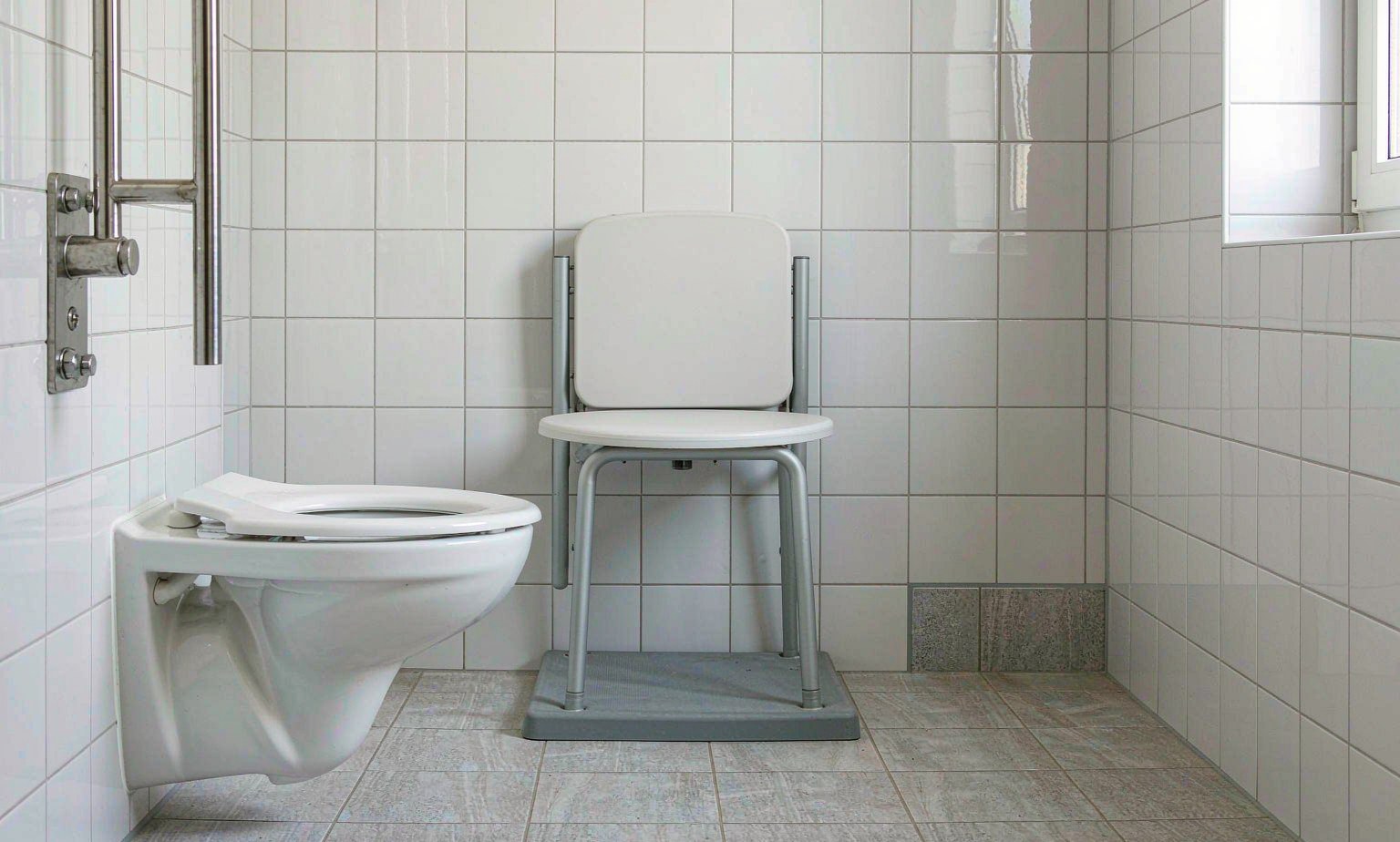
The pattern repeats room by room across assistive devices. In the bathroom, products that fit a household budget are rarely networked: a commode chair that sits over an existing toilet, a raised toilet seat, a grab bar fixed into tile, a shower chair with arms, a transfer bench, a non-slip bath mat. In the bedroom the care bed has become the natural host for electronics, because the family is buying the frame anyway, so a bed rail with an integrated bed exit alarm, a pressure relief mattress and an overbed table sell as one package. At the table, a divided plate, a two-handled cup and adaptive utensils still move in volume because the buyer grasps the problem in a second. On the move, a rollator, a transfer board, a gait belt and a lift chair follow the same rule, and a pressure relief cushion attaches to almost every wheelchair order. Only then do sensors earn a place: a fall detection radar on the ceiling, a smart care bed feeding remote patient monitoring software, an emergency call button by the pillow, a pill organizer on the nightstand.
Read this way, 3.5 percent is less a verdict on technology than a map of shelf space. A product that invents a category has to explain itself, find a channel and train a shop assistant; a product that replaces something already in the bathroom cabinet does none of that. With only 12.8 percent of older Chinese reporting any age-friendly modification at home, the volume sits in the retrofit side of ageing in place, favouring items a family can fit with a screwdriver and no technician. Suppliers that treat connectivity as an upgrade inside a category that already sells, not as a new product line, will find the arithmetic kinder. That is why the care bed, not the humanoid, has become the hub of the connected home for seniors.
The second lesson concerns which specifications travel. Subsidy schemes pay for device classes a caregiver touches every shift, which explains why transfer lifts and non-contact sensors reach official lists while companion robots do not. Procurement officers in Europe and North America apply the same test, asking for documents many small factories lack: a battery certificate for anything with a lithium pack, a clear statement on medical device classification, spare parts across five years, and data that can leave a proprietary app. Price discipline matters too, since households headed by someone in their seventies rank cost above features, and a stair-climbing power wheelchair above 10,000 yuan or a home exoskeleton near 6,000 yuan still stalls at the till. The winning category keeps a caregiver's back working another year for a few hundred dollars, in a box that fits through a bathroom door.
Yiwu Orange Light Future Technology keeps a close eye on global trends in elderly health. Specializing in age-friendly wellness products, we offer a range of mature solutions to support seniors' safety and health at home. We welcome inquiries and business discussions from all partners!
RELATED NEWS
- New business opportunities in the silver economy: The elderly toy market is on t
- Active Ageing: Seniors Rebuild Self-Worth via Travel and Social Connection
- The 3rd Global Congress of Age-Friendly Cities Convenes as Countries Establish a
- Global Rise of Silver Volunteering: Seniors Share Experience to Give Back
- Ageless Travel: Senior Women in Europe and America Embrace Solo Travel
CATEGORIES
LATEST NEWS
CONTACT US
Name: Fannie
Mobile:+86 13375799060
Tel:+86 13375799060
Whatsapp:+86 13375799060
Email:fannie@ywolftech.com
Add:589 Longtan Road,Jinhua City Zhejiang Province China